Episcopal Church Women

About Episcopal Church Women

This author has not yet filled in any details.
So far Episcopal Church Women has created 452 blog entries.

It Was a God Moment

Mary-Hansen-WolfeBy Samar Fay

It almost didn’t happen. A minute or two either way and two women would never have reconnected threads that were about 50 years old.

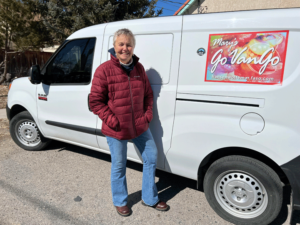
Mary Hansen Wolfe, pictured right, and her niece were traveling in the fall of 2016, heading back to Mary’s home in Salida, Colorado, after a painting trip to the Vermilion Cliffs in Arizona. On a whim, Mary suggested they detour a bit to Navajoland in the northeastern corner of the state to visit the school where she had been a guidance counselor and head of the dormitory back in 1967-68. Nazlini is still a tiny community of about 500 people, home to a Bureau of Indian Education boarding school. The dormitory housed about 140 children in Mary’s time, kids who lived too far away to travel back and forth every day.

It took them a while to find the school because the roads and landmarks had changed. The school building and dormitories were replaced in the 1980s. They walked around the buildings, aware that they would immediately be seen as strangers and hoping not to be intruders. When a door opened and a woman stepped out, Mary identified herself as the one who had run the dorm 50 years ago.

“You wore a leather bracelet,” the woman said. “You played the guitar and sang ‘The Fox Went Out on a Chilly Night’ and you took us on wonderful hikes. You’re Miss Hansen.”

This woman was Lorraine Nells, who was a second-grader when Mary was at Nazlini School.

“It was a God moment,” Mary said later in an interview. “One minute sooner or later and we wouldn’t have met.”

Lorraine, who works at the dormitory, and Mary chatted for a while about the changes in the K-6 school, which boarded about five students last school year, now that the district has school buses. Mary later received a letter from Lorraine, asking for prayers for the school.

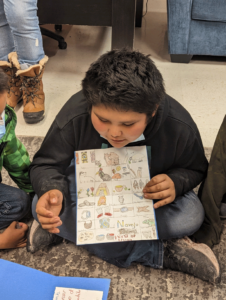
God-Moment-BoyMary related this experience at a mid-week healing service at her home church in Salida, the Episcopal Church of the Ascension. Ascension’s rector, The Rev. Melissa George, asked if the church could help – and so a campaign began. During the winter of 2022 and into the spring, the church collected donations of children’s clothing, shoes, books, toys, games and art supplies, plus bedding and shelf-stable food. Donations and help also came from Ascension’s mission church, Little Shepherd in the Hills, in Crestone, Colorado. Volunteers sorted and boxed the donations in the church undercroft.

In early April, the boxes were blessed and loaded into three vehicles, and the caravan made the three-day round-trip to Nazlini.

The donations will help not only the children in the dormitory, but also their classmates in school. Perhaps when they put on a warm winter coat or read a story book, they will remember that their teacher has a friend from a long time ago, and threads of friendship last a long time. They can grow, too, and encircle new people in a church who learned about Navajo children and care about them. The church hopes to maintain a relationship with the school.

2023-12-08T14:59:37+00:00December 8th, 2023|

Desigualdades en la Salud de Mujeres de Raza Negra

Recientemente, ha habido mucha desinformación sobre el estatus de la salud reproductiva de las mujeres en los Estados Unidos. Poca atención se ha prestado a la falta de equidad para las mujeres de raza negra. En la Publicación de la Salud de las Mujeres, Volumen 30, No. 2, los escritores Juanita. J. Chin, Imán K. Martin, y Nicole Redmond no solo discutieron las bases históricas de esta falta de equidad, sino que también enfatizaron la necesidad de la equidad en la salud.

Históricamente, las investigaciones concluyen que las mujeres de raza negra han sido subyugadas a una opresión sistemática, y a un tratamiento inadecuado. Evidencia posterior muestra que las mujeres de raza negra en los Estados Unidos han experimentado un tratamiento racial distinto. La Discriminación y la Segregación, y las leyes han suprimido a las mujeres de raza negra y a las mujeres en general en los Estados Unidos.

Los autores también creen que tú no puedes discutir el problema sin considerar el impacto en la salud física. La salud mental y física están interconectadas. A continuación, uno de los problemas presentados en la publicación:

Desorden de estrés Obesidad Enfermedad Cardiovascular Desorden de sangramiento

Mortalidad Materna Salud mental Salud de la maternidad mental

Desde 1995, El Centro epidemiológico de Piedra de la Universidad de Boston, el estudio de la salud de mujeres han estado investigando por que las mujeres de raza negra tienen un mayor índice de padecimiento en lo atinente a ciertas enfermedades. Estas enfermedades incluyen lupus, hipertensión, diabetes, enfermedades cardiovasculares, y cáncer desde una edad temprana.

Si nosotros como Sociedad estamos enseriados en la mejoría de las disparidades en la salud de mujeres de raza negra, entonces tenemos que remover las obstrucciones que previenen la salud igualitaria. Racismo y estrés son ejemplos de obstáculos que interfieren en la consecución de una salud óptima para con las mujeres de raza negra. Nosotros también que lidiar con el problema racial y de género. Además, tenemos que explorar maneras de intervención y prevención. Una seria atención debe ser dad a la creación de equidad en la justicia reproductiva que se alinean con derechos humanos.

by Annie Kate Jacobs – Social Justice Member at Large

2023-12-07T16:34:47+00:00December 7th, 2023|

Inequalities in Black Women’s Health

Recently, there has been a lot of information on the status of women’s reproductive  health in the United States. Little attention has been paid to the lack of health equity for Black women. In the Journal of Women’s Health, Vol. 30, No. 2, writers Juanita J. Chin, Iman K. Martin, and Nicole Redmond not only discuss the historical basis of this inequity but they also stress the need for health equity.

Historically, research shows that Black women have been subjugated to systematic oppression, bias, and inadequate treatment. Further evidence shows that Black women in the United States have experienced a racial difference in treatment. Discrimination, segregation, and laws have suppressed Blacks and women in the United States.

The authors also believe that you cannot discuss this issue without considering the impact on physical health. Mental and physical health are intertwined. Here are some of the physical issues presented in the article:

  • Weathering Obesity
  • Cardiovascular disease
  • Bleeding and blood disorder
  • Maternal morbidity and mortality
  • Mental Health
  • Maternal mental health

Since 1995, Boston University Stone Epidemiology Center Black Women’s Health Study has been investigating why Black women have higher rates of certain illnesses. These illnesses include lupus, hypertension, diabetes, and stroke as well as breast cancer at a young age. If we as a society are serious about improving disparities in the health of Black women, then we need to remove the obstructions to equal health care.

Racism and stress are examples of obstacles that interfere in the pursuit of optimum health care for Black women. We must also look at and deal with race and gender. In addition, we need to explore ways of intervention and prevention. Serious attention should be given to creating equity and reproductive justice that are more in line with human rights.

by Annie Kate Jacobs – Social Justice Member at Large


2023-12-07T16:27:07+00:00December 7th, 2023|

La Colaboración Renacentista

El segundo piso del edificio “La Colaboración Renacentista” en Chicago, IL. tiene un portal al pasado. El antiguo edificio de la YMCA ha renacido como servicio de apoyo y lugar de vivienda asistida para los habitantes de Chicago que lo necesitan. Como ocurre con todos los edificios antiguos, algunas cosas funcionan y otras no. El ascensor de entrada no es una excepción y forma parte de los aspectos que no funcionan en los proyectos de renovación de edificios antiguos. Sin embargo, cuando la Junta Nacional visitó el lugar en la primavera de 2023, erigieron alegremente las antiguas escaleras de mármol y, al hacerlo, se sumergieron en un edificio que irradiaba historia y un legado imperecedero.
En 1913 se inauguró la YMCA de Wabash y, por diseño, pasó a desempeñarse como la primera YMCA en la región central del Oeste del país en atender a personas de color. El edificio histórico fue el corazón del progreso cultural y económico de los afroamericanos en la región de Bronzeville en Chicago durante más de medio siglo, y es aclamado como el lugar de nacimiento del Mes de la Historia Afroamericana.

A lo largo de los años, las instalaciones han albergado eventos deportivos, educativos y culturales que apoyaron a la comunidad local mediante el uso de su cancha de baloncesto, piscina, salones comunitarios y apartamentos. En el gimnasio actuaron artistas de renombre como los Trotamundos de Harlem en la década de 1940. El mural de la “Mente, Cuerpo y Espíritu” de William Edouard Scott, pintado en 1936, fue resguardado de la demolición por la Colaboración Renacentista (The Renaissance Collaborative) durante sus renovaciones en curso. Hoy en día, el mural sirve como foco de esperanza e inspiración para los residentes que antes estaban sin hogar mientras trabajan por ser autosuficientes.

Hablar del edificio como una entidad singular ilustra la dedicación de la comunidad por la estructura, pero aún así, los cambios culturales provocados después de la Segunda Guerra Mundial cambiaron la sociedad de muchas maneras. En la década de 1960 se sintieron tiempos difíciles y en 1969, la entidad del YMCA fue cerrada. En 1982, Wabash YMCA se vendió a la iglesia episcopal vecina de Santo Tomas por un dólar.
En 1992, Las Iglesias de Santo Tomas (Episcopal) ubicada en Quinn Chapel AME y la de Santa Elizabeth (católica) formaron una asociación ecuménica para auxiliar a Wabash YMCA  de la demolición, nombrando a su asociación la Corporacion Renacentista “The Renaissance Corporation”. Liderados por Patricia Abrams, esta sociedad recaudo casi $11 millones para restaurar el edificio.

La propia Sra. Abrams proporcionó a las miembros del Grupo de Mujeres de La Iglesia Episcopal (ECW) coloridas historias sobre la renovación del edificio junto con un recorrido a pie por los terrenos. Durante la visita de la Junta de Directores, la representante de la Provincia V, la Señora Jan Goossens, y la presidenta de NECW, la Señora. Karen Patterson, entregaron a la Señora Abrams un cheque de subvención por valor de $000 dólares. Los fondos se destinarán a ayudar a la organización sin fines de lucro a continuar con su legado de viviendas de apoyo, desarrollo de la fuerza laboral, preservación de la historia de las personas de raza negra, sostenibilidad ambiental y desarrollo comunitario.

El Renacimiento utiliza un enfoque de desarrollo comunitario basado en activos, centrándose en identificar y aprovechar las fortalezas de una persona en lugar de centrarse en sus debilidades. Tras afianzar un sentido de autoestima y promoción del bienestar integral, su objetivo es el de restaurar vidas. En el lugar se encuentran 101 apartamentos de ocupación individual para adultos que anteriormente estaban sin hogar. Los residentes reciben medios rentables para pagar el alquiler, además de educación y formación profesional para garantizar su éxito en la sociedad. Aunque los residentes pueden quedarse el tiempo que sea necesario, los servicios tienen como objetivo aumentar los ingresos y la independencia de los residentes para que puedan reingresar exitosamente a la comunidad.

La Villa para las Personas de Tercera Edad 1 (Senior Village 1) es un centro de vida independiente de 71 unidades para personas de la tercera edad con bajos ingresos. La misión de la Villa para las Personas de Tercera Edad es la de fomentar un entorno donde las personas mayores sean participantes activos y saludables dentro de la comunidad, alcanzando así su máximo potencial y calidad de vida. Ubicado dentro la Villa para las Personas de Tercera Edad también hay un centro geriátrico de salud y bienestar abierto a todos los residentes y personas mayores que viven en derredor de la comunidad misma.

La Villa de Personas de la Tercera Edad de la Colaboración Renacentista es socia fundadora de La Red de Expertos de Envejecimiento Saludable en el lado Sur (Siglas en Ingles SHARE) de la Universidad de Chicago, la cual es una red sólida y comprometida con adultos mayores, cuidadores, proveedores de atención primaria y especialistas en envejecimiento que comparten recursos y educación para mejorar la salud de adultos mayores en el lado sur de Chicago. Gracias a esta asociación, variopintos especialistas en envejecimiento visitaron recientemente La Villa de personas de La Tercera Edad TRC, y ofrecieron charlas de salud sobre el manejo de medicamentos, artritis, salud cardíaca y actividad física.

En Julio de este año, La Señora Abrams se jubiló de la Colaboración Renacentista. Su Transición de líder a observadora no estuvo exenta del como ella vislumbraba a las futuras generaciones pasando a través del viejo edificio de Wabash YMCA. Durante su anuncio de jubilación ella paso a decir, “La antorcha es ahora de ustedes para empoderar a los hombres y dejar un impacto duradero en nuestra amada comunidad de Bronzeville.”


2023-12-07T14:58:07+00:00December 7th, 2023|

The Renaissance Collaborative

The second floor of The Renaissance Collaborative building in Chicago, IL. holds a portal to the past. The former YMCA building has seen a rebirth as a support service and assisted housing location for Chicagoans in need. As with all old buildings, some things work and some things don’t. The entryway elevator is no exception and falls to the not working aspects of old building renovation projects. However, when the National Board visited the location back in Spring of 2023, they gleefully climbed the ancient-marble stairs and in so doing were immersed in the embrace of a building that shared her history and ongoing legacy.

In 1913 the Wabash YMCA opened and by design went on to act as the first YMCA in the Midwest to serve people of color. The historic building was the heart of cultural and economic progress for African Americans in the Bronzeville region of Chicago for over half a century and is hailed as the birthplace of Black History Month.

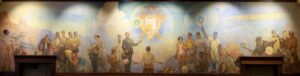
Over the years, the facility has hosted sports, educational, and cultural events that supported the local community through the use of its basketball court, swimming pool, community rooms, and apartments. Big name acts such as the Harlem Globetrotters performed in the gymnasium in the 1940’s. The mural Mind, Body, and Spirit by William Edouard Scott, painted in 1936, (pictured on next page), was saved from demolition by The Renaissance Collaborative during their ongoing renovations. Today the mural serves as hope and inspiration for the formerly homeless residents as they work toward obtaining self-sufficiency.

To speak of the building as a singular entity illustrates the community’s dedication for the structure but still, the cultural changes brought on after World War II changed society in many ways. Hard times were felt in the 1960’s and in 1969, the YMCA was closed and shuttered. In 1982 the Wabash YMCA was sold to neighboring St. Thomas Episcopal Church for one dollar.

In 1992, St. Thomas Episcopal, Apostolic Faith Church, Quinn Chapel AME, and St. Elizabeth Catholic Church formed an ecumenical partnership to save the Wabash Y from demolition, naming their partnership “The Renaissance Corporation.” Led by Patricia Abrams, these partners raised nearly $11 million to restore the building.

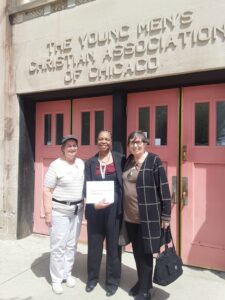
Ms. Abrams herself provided the ECW women with colorful stories of the renovation of the building along with a walking tour of the grounds. During the Board’s visit Province V representative Ms. Jan Goossens and NECW president Ms. Karen Patterson presented Ms. Abrams with a grant check for $1000. The funding will go to helping the nonprofit continue its legacy of supportive housing, workforce development, black history preservation, environmental sustainability, and community development. The Renaissance uses an asset-based approach to community development, focusing on identifying and building upon a person’s strengths rather than focusing on their weaknesses. By instilling a sense of self-worth and promoting holistic wellness, their ultimate goal is to restore lives. Located onsite are 101 single-resident-occupancy apartments for formerly homeless adults. Residents are provided with a cost-effective means to afford their rent along with education and skills training to ensure their success in society. Although residents are able to stay as long as needed, services are intended to increase a resident’s income and independence so they can successfully re-enter the community.

Senior Village 1 is a 71-unit independent living facility for low-income seniors. The mission of Senior Village is to foster an empowering environment where seniors are active, healthy participants in the community, achieving their full potential and maximizing their quality of life. Located in Senior Village is a geriatric Health & Wellness Center open to all residents and local seniors.

The Renaissance Collaborative Senior Village is a founding partner of the University of Chicago’s Southside Healthy Aging Resource Experts (SHARE) Network—a robust, engaged network of older adults, caregivers, primary care providers and aging specialists who share resources and education to improve health for older adults on Chicago’s South side. Due to this partnership, numerous aging specialists have recently visited TRC Senior Village, offering health presentations on medication management, arthritis, heart health, and physical activity.

In July of this year, Ms. Abrams retired from The Renaissance Collaborative. Her transition from leader to observer is not without a glimpse into how she sees future generations passing though the old Wabash YMCA building. In her announcement she went on to say, “The torch is now yours to empower folks and make a continued and lasting impact on our beloved Bronzeville community.”


2023-12-04T17:07:41+00:00December 4th, 2023|

El Proyecto de Hacienda de la Escuela Primaria Santiago

La Junta Nacional recientemente aprobó una subvención para las vacas. Las Vacas Lecheras para niños en el Sur de Sudan. La Señora Kate Jacobs, encargada de la Justicia Social para la Junta, anunció la subvención vía correo electrónico:

Querida Elizabeth Nyirou Thuc:

Gracias por su más reciente pedido para la Junta Nacional del Grupo de Mujeres de la Iglesia Episcopal (ECW) en lo atinente a la subvención del CUEED y el proyecto de hacienda de la Escuela Primaria Santiago.

Estamos honrados de ayudarte con este proyecto al hacer una donación de $1,300.00 para poder comprar dos vacas por el precio de $650.00 cada una.

De nuevo, felicitaciones y anhelamos escuchar de ustedes pronto.

Dios los bendiga,

Annie Kate Jacobs, Encargada de la Junta Directiva

Justicia Social (NECW)

Cristianos Unidos por el Evangelismo, Educación y Desarrollo (Siglas en ingles CUEED) es una organización sin fines de lucro, y apolítica fundada en el año 2010 y actualmente operada en el condado de Rual en Awan Pajok, diócesis de Gogrial en el Sur de Sudan.
CUEED y el comité gerencial de la escuela primaria de San Santiago luchan por el desarrollo. Los niños de la escuela primaria de San Santiago están aprendiendo a la intemperie bajo los árboles y las aulas de clases requieren más fondos para ser construidas, y por esta razón, CUEED está preparada para aplicar por fondos y enviarlos para su consideración durante la reunión.

CUEED está planeando el comprar 50 novillas preñadas para la expansión de las pocas vacas de la escuela primaria de San Santiago por las que CUEED está tratando de solicitar donaciones para contribuir con cualquier monto que se pueda para este proyecto donde una novilla preñada vale $650.00 y las donaciones pequeñas, medianas, y grandes son también bienvenidos.

CUEED ha establecido una granja lechera en la escuela primaria Rual y la escuela primaria San Pablo, y la gerencia de las dos escuelas tiene fondos necesarios. CUEED cree que en la generación de capital el proyecto per se es una manera de mirar al futuro para que los comités gerenciales obtengan dicho capital el cual les permitirá la construcción de edificios a través de los fondos del proyecto.

Respetuosamente le envió el proyecto de la granja lechera para la Escuela Primaria San Santiago para su apoyo. Las siglas CUEED en ingles significan en español “Cristianos Unidos por el Evangelismo, Educación, y Desarrollo. Fundado por miembros de la Iglesia Episcopal, trabajando en dos Diócesis Episcopales, Gogrial y Nyamalel en el Sur de Sudan. Dios los bendiga, tuya en Cristo.

Eliabeth Nyirou Thuc – Directora de Proyectos

cueedss.org


2023-12-04T15:54:51+00:00December 4th, 2023|

James Primary School Farm Project

The national board recently approved a grant for cows. Dairy cows for children in South Sudan. Ms. Annie Kate Jacobs, Social Justice Chairperson for the Board, announced the approval of the grant via email:

Dear Elizabeth Nyirou Thuc:

Thank you for your recent request for a National ECW Board Grant for the CUEED and St. James Primary School Cows Dairy Farm Project.

We are honored to help you with this Project by funding $1,300 to purchase two cows for $650 each.

Again, congratulations and we look forward to hearing from you.

God bless,

Annie Kate Jacobs, Chairperson

NECW Social Justice

Christians United for Evangelism, Education and Development (CUEED) is a South Sudan indigenous non-profit, non- commercial and non-political organization founded in 2010 and the NGO is currently operating at Rual in Awan Pajok County, Gogrial Diocese in South Sudan.

CUEED and St. James Primary School management committee are struggling with the development, Children of St. James Primary School are learning under trees and the classrooms are demanding more money to be built. With this reason, CUEED office has  prepared an application request for funds and sent it to you for your consideration in your meeting. CUEED is planning to buy 50 pregnant Heifers for expansion of the cow herd at St. James Primary School. You will see their photos on the attached project proposal. CUEED is working to request any respectful Donors to contribute any amount of money that the donor is able to pay for this project. One pregnant Heifer is $650 and we welcome all gifts small, medium and big.

CUEED has established a cattle dairy farm in Rual Primary School & St. Paul Primary School. The management committees of the two schools get good income. The project is a way forward for management committees of primary schools to earn more money which will enable them to build concrete school buildings.

This Cows Dairy Farm project for St. James Primary School is being sent to you  for your support. CUEED mean Christians United for Evangelism, Education and Development. It was founded by Episcopal Church members working in two Episcopal Dioceses, Gogrial and Nyamalel in South Sudan. God bless you. Yours in Christ.

Eliabeth Nyirou Thuc – Projects Director –  cueedss.org


2023-12-04T15:49:05+00:00December 4th, 2023|

Episcopal Church Women in the News 09-23-23

Episcopal Attendance Bounces Back 19% from Pandemic Low

We have fewer parishes and we have fewer people,” said the Rev. Molly James, deputy executive officer of the General Convention

Churches work together to care for needs of the community

“It really allows us not to be spending the resources we have in our own churches because we’re all small,” Murray said. – Woodstock, VA

House of Bishops hears Title IV overview and timeline of House of Deputies president’s case

“It does not mean that it isn’t an issue that needs to be addressed,” Ousley said. “It means Title IV is not the appropriate venue for that.”

Presiding Bishop Michael Curry recovering in ICU following surgery

He is expected to remain in intensive care for about 24 hours.

St. Mark’s “Messy Church” – resumes Sunday

Messy Church offers a once a month worship experience for busy families of younger kids. – Southborough, MA

Indigenous Art Show In Jackson Hole

St. John’s Episcopal Church is thrilled to be hosting dozens of regional indigenous artists. – WY

Grace Church welcomes new pastor

Rev. Christy Shain-Hendricks priest living in Salida, Colorado

Blessing Box brings bounty to Chester

Turner’s idea came to her after seeing the benefit of the Blessing Box at her own church. – Warwick, NY

———

Women’s Retreat at St. Crispin’s September 22-24, 2023

This retreat is sponsored by the Episcopal Church Women of the Diocese of Oklahoma. We welcome all women who wish to gather in this space for a weekend of prayer, study, renewal, refreshment, and fellowship as we take a break from our everyday lives. St. Crispin’s Conference Center 36302 State Highway 9 Wewoka, OK 74884

Contact Sandra Opalka, treasurer: sandra.opalka@gmail.com

The Nonviolence Institute is pleased to announce our 14th annual Invest in Peace fundraise

September 21, 2023 at Farm Fresh Rhode Island. This year’s event, will again celebrate our Sister Ann Keefe Award winner and our Community Impact Award winners, who will be named in the short future. We look forward to welcoming and gathering with those who care deeply about our work and recognize that this is an opportunity to consider the importance, in this moment, of our Beloved Community, reflective of the actions and teachings of Dr. Martin Luther King, Jr.

Love in Action: Environmental Justice in RI

Join the discussion with local and national leaders in the environmental justice space as we explore how environmental justice and racism continues to impact communities across Rhode Island, efforts to address the disproportionate harm climate change continues to have on many of our most vulnerable communities, and what role we can play to address this critical issue impacting the communities we are called to serve. We are excited to announce our keynote speaker is Karyn Bigelow- Co-Executive Director for Creation Justice Ministries. to register, contact: Sept 23rd

https://www.eventbrite.com/e/the-2023-edri-conference-for-creation-care-tickets-654950934877?aff=oddtdtcreator

ECW of Delaware ECW Annual Meeting, Luncheon and Worship

October 7, 2023.

The Program will include brief talks from Mathy Downing, UTO Province III member of the National UTO Board. Cindy Mohr, ECW Province III member of the National ECW Board. A representative from Primeros Pasos, our outreach target for this year. • The Business Meeting will include election of President and Vice-President. Questions contact:Beth FitzPatrick, gr8art@outlook.com

Arkansas ECW Fall Gathering – Oct 13 – 14

Fall Gathering is ECW’s statewide annual meeting and a time for fun and fellowship. This year, we are honored to have the Rev. Susanne Methven of Tulsa, OK, as our speaker. We are excited that St. Bartholomew’s Episcopal Church will host our annual Fall Gathering! All events Saturday will be held in the parish hall and sanctuary. To register and more info

Episcopal Church Women Diocese of Mississippi Annual/Fall Conference

Saturday, October 21, 2023

SPEAKER: Rev. Deacon Becca Walton,Curate, All Saints, Tupelo Presentation: My experience as a mbr of the Community of St Anslem, a new monastic RSVP by October 4, 2023 to:episcopalchurchwomenms@gmail.com

Using Picture Books for Racial Healing

Registration is now open for Dismantling Racism training sessions in August, September, October, and November. Miriam McKenney leads the trainings, which take place on Zoom.

Choose 1 month:

  • September (12, 19, 26 from 6 to 8 p.m.). Sign up here.
  • October (10, 17, 24 from 6 to 8 p.m.). Sign up here.
  • November (1, 8, 15 from 1 to 3 p.m.). Sign up here.

“The dismantling racism course is terrific,” Lisa Barker of St. Patrick’s, Dublin, says. “The use of storytelling and scripture brings things into focus that, for me, had been unacknowledged. Another wonderful aspect of this course is the formation of community among the participants. Miriam and Emma made the course easy to access, consistent with the Four-Fold Path of Love, and I truly looked forward to the sessions. Our discussion times flew by as the topics were thought-provoking. I highly recommend this course!”

Email Director of Dismantling Racism in Southern Ohio, Miriam McKenney, to learn more.

2023 Fall Speaker Series – ECW Diocese of Chicago

by Zoom – Register here

October 4 – Hunger – A Continuing Paradox?

October 11 – Springboard Kitchen: Helping People Reach Next Stage Culinary Dreams

October 18 – Sustainable Gardening

View Past Women in Action News Blasts

2023-09-22T15:23:37+00:00September 22nd, 2023|

Mira Washington from Church Women United

Mira Washington Church Women United with 2023 Board Mira Washington from Church Women United, CWU, spoke to the board this past Saturday while they all met in Syracuse for a board meeting. She went on to visit with the board members for the rest of the weekend and shared many delightful stories about the lives of Christian women and how their dedicated service is honored around the world.

The CWU is celebrating their 82nd year and Ms. Washington is their youngest elected president. She was raised in the organization and has been a member for nearly thirty years. “Social justice is not just my passion but Church Women United’s passions,” she said. “In fact, the CWU was one of the organizations in operation following World War Two when Elinor Roosevelt went looking for assistance in rebuilding after the war.”

“The average age of women in the organization is 78 years old. We are diversified from all ethnic cultures.” They advocate for women and the issues that impact women. Since her term started, they have developed a vision statement and focused on a true cause. Her hope is to rekindle participation in the World Day of Prayer.

She went on to explain what Justice and Righteousness means to Church Women United:

  1. Health Equity – God’s Word: On hearing this, Jesus said, “It is not the healthy who need a doctor, but the sick. But go and learn what this means: ‘I desire mercy, not sacrifice. For I have not come to call the righteous, but sinners.” Matthew 9:12-13 NIV
  2. Climate Stewardship – God’s Word: But ask the animals, and they will teach you. Or the birds in the sky, and they will tell you; or speak to the earth and it will teach you, or let the fish in the sea inform you. Which of all these does not know that the hand of the Lord has done this? In his hand is the life of every creature and the breath of all mankind. Job 12:7-10
  3. Social justice – God’s Word: “In the temple courts (Jesus) found people selling cattle, sheep, and doves and others sitting at tables exchanging money. So he made a whip out of cords, and drove all from the temple courts, both sheep and cattle; he scattered the coins of the money changers and overturned their tables. To those who sold doves he said, ‘Get these out of here! Stop turning my Father’s house into a market.” His disciples remembered that it is written, ‘Zeal for your house will consume me.’” John 2: 14-17
  4. Hunger and poverty – God’s Word: He will bring justice to the poor of the people; He will save the children of the needy and will break in pieces the oppressor. Psalm 72:4 NKJV

“We ask our regions and their member states to align themselves with the Church Women United national organization’s policies. We are sustaining ourselves on donations from state and local groups,” she said. They have also been blessed with endowments from many of their long-term members.

Their social policies have been written since 1941. “We are still facing some of the ethnic and gender national policies that are substandard for women in our culture.”

She speaks of harmony in the home and in the church. “We work to support all denominations as they come to us for assistance. I’ll be very transparent; I am very traditional, and my husband is progressive.” As churches evolve to a more progressive policy, she sees the first hurdle being harmony at home and then the congregation.

2023-08-11T15:04:53+00:00August 11th, 2023|

Cansado de estar Solo Entendiendo Nuestra Soledad en un Mundo Hiperconectado

Escrito por La Diacono Patrice Al-Shatti

Mi experiencia con la soledad es amplia y profunda. En el 2012, mi esposo falleció a causa de haberse suicidado tras una ardua lucha con la soledad y la depresión, y como trabajadora social he conocido pacientes que carecen del apoyo necesario y han enfrentado enfermedades serias solos. He visto y sentido la devastación creada por la soledad crónica, y, por ende, decidí tempranamente en mi formación que sería mi ministerio diaconal.

La soledad afecta a más de la mitad de los americanos, que les dicen a los investigadores que a veces o siempre se sienten solos. El cuarenta por ciento de ellos se sienten aislados de otros, y la mitad dice que no tienen interacciones significativas sociales de manera diaria. El descubrimiento más alarmante en el estudio acerca de la soledad es que cuatro de cada diez de nosotros admitimos que no tenemos a nadie para compartir noticias importantes. Y la soledad va más allá de los estereotipos. En el 2018, los jóvenes de los 18 a 22 años fueron declarados la generación solitaria, y no la gente de la tercera edad. Y la tasa de suicidios más elevada, un factor determinante en la medición de la soledad, se encuentra entre los hombres de edad media. Estas tendencias son realmente preocupantes, porque cada vez más vivimos solos, no nos casamos ni tenemos hijos, y la taza de divorcio entre la población de más de 50 años se ha duplicado desde el año 1990.

La soledad crónica es peligrosa. Es físicamente nociva para la salud-similar al fumarse 15 cigarrillos diarios-Y la gente solitaria son 50% más dadas a morir en cualquier año que las personas socialmente conectadas. La soledad también afecta nuestra habilidad para concentrarnos, regular nuestras emociones y desarrollar una serie de tareas cognitivas y emocionales.

Nuestra cultura actual es el clima perfecto para fomentar el aislamiento y la soledad, y todos tenemos malos hábitos que nos ponen en riesgo. Somo individuos altamente individualistas que nos enorgullecemos en ser autodependientes, ergo, no buscamos ayuda. Nos la mantenemos ocupados todo el tiempo y nos alejamos de la vida comunitaria porque creemos que no tenemos tiempo. En consecuencia, no nos comprometemos a actividades sociales por temor a comprometernos demás, y dejamos de acercarnos a otras personas porque no queremos molestar. Así que nos sumergimos en nuestros teléfonos celulares en vez de cultivar relaciones, y nuestros amigos en las redes sociales terminar por suplantar nuestras amistades reales, pero estudios muestran que el uso excesivo de las redes sociales conduce a la depresión. El trabajo nos tiene en nuestras computadoras absorbidos o trabajando solitariamente. Y los lideres de salud pública se están empezando a preocupar que la camaradería en el lugar de trabajo es cosa del pasado.

La Iglesia Episcopal de “Todos Los Santos” lanzo una campaña de concientización en el 2020, y se puede conseguir material en la página web allsaintsoncentral.org/loneliness-project que podría ayudarte a educar a tus seres queridos. La pandemia fue una experiencia de aislamiento, y quizás de soledad para todos nosotros. Aprendamos sus enormes lecciones.  Estamos diseñados por el Ser Divino para amarnos unos a otros.

Patrice sirve en la parroquia de “Todos Los Santos” en la ciudad de Phoenix y fue ordenada en junio de 2019. Ella funge como Trabajadora Social y en la actualidad esta jubilada tras una larga carrera médica y geriátrica en las lides del Trabajo Social en el año 2014.

2023-08-01T19:15:34+00:00August 1st, 2023|
Go to Top