Episcopal Church Women

About Episcopal Church Women

This author has not yet filled in any details.
So far Episcopal Church Women has created 447 blog entries.

Season of Creation We are Living Waters Week 5

Season of Creation

What are the Episcopal Church Women to do?
Are we the women at the well?
Are we the woman protecting the well?

 In ancient Israel, maintaining the household was the work of the woman. Carrying jars or skins of water weighing 35–45 lbs (16–20 kg) on the head or hip was not unusual regardless of one’s age. In the video from week 2, “Living without Clean Water,” 12-year-old Tarique made that trek every day to gather dirty water to bring back to her family. Remember the man? He had difficulty keeping up with a 12-year-old (https://www.youtube.com/watch?v=yPxMOzN0Uq4).

In Genesis 24:18-20, Abraham’s servant was sent to find a husband for Issac, one of Abraham’s sons. When the servant arrived at the town of Nahor, he stopped at the well with his camels and wished that one of the women who came to the well would be the wife for Isaac. Rebekah was one of the women who came to the well and “quickly lowered her jar to her hands and gave him a drink” and then “ran back to the well to draw more water and drew for all his camels.” In doing this, Rebekah demonstrated both strength and the expectation that a woman could supply substantial quantities of water without additional help. How are women today reacting to the water needs of the world?

We are one with the waters of creation.
We are one with each other through the waters of creation.
We are Living Waters.

Commencement. We tend to think of a commencement as an ending, like, graduating from high school or college. However, commencement is about beginning, a new beginning. One path or process is ending while giving life to a new path or process – commencing a new path or process. We have information, for some it might be too much; however, what are we going to do with it? How can we or can we turn the misuse or abuse of water around? How can we ensure all people have access to clean and abundant water? What is the future of water management if we continue to consider it a commodity, something to be sold and bought? Should it be a commodity? How do we unite across communities, across parishes, denominational or faith community boundaries to make sure people have what they need?

Let us pray: Algonquin Water Song; Women, Water Carriers, and Protectors –

https://www.youtube.com/watch?v=dDGWuPUH5_A&list=RDnJstnFx-PUI&index=5

Review the following videos:

This week’s task:

What are the Episcopal Church Women called to do as part of Creation Care? Creation care is about stewardship. In Genesis, humankind was given dominion over all God created – for God’s purposes. We have been made caretakers for what is Gods to be used for God’s people. What are YOU going to do to make this a reality? What is your ECW chapter willing to do to ensure the water God created is available for God’s people?

We know there are some simple steps we can take that were shared at the beginning of this journey. We can change to low flow shower heads and toilets, take shorter showers, have fewer water-thirsty lawns, stop rinsing dishes before using the dishwasher and use the dishwasher. We can continue to collaborate with organizations that work with communities around the world assisting women and girls, saving their lives and ours because we are all connected. What can we learn from cultures other than our own?

Do not overwhelm yourselves. Keep it simple if this is something new. You can expand if your chapter is already doing something. Let’s not wait until our taps go dry.

Let us remember Kweli’s journey (from week 1) which is part of ours:

The creek connects to the river.
The river connects to the ocean.
The rain connects to the aquifer.
The plant connects to the land.
The pigment connects to the plant.
The remnant connects to memory.
The ancestor connects to the descendant.

And I am somewhere within all of these relationships, receiving, observing, creating, and carrying something forward.

The water carries.

The plants carry.

I carry.

Share what you are doing or going to do on the ECW Facebook page (https://www.facebook.com/ecwnational/).

As we commence, let us pray in song: We pray for the waters — We pray to the waters: https://www.youtube.com/watch?v=aIi2Lrb8GZ8&list=RDnJstnFx-PUI&index=6

Water of Life — https://www.youtube.com/watch?v=CRazuibrxAs&list=RDCRazuibrxAs&start_radio=1

Thank you for taking this journey toward ensuring people have water because we as Episcopal Church Women are Living Waters.

2026-08-24T16:37:50+00:00August 24th, 2026|

Season of Creation We are Living Waters Week 4

Season of CreationThe poor and needy search for water but there is none; their tongues are parched with thirst. But I the Lord will answer them; I, the God of Israel, will not forsake them.” Isaiah 41:17

From: Fortune Magazine

Largest U.S. reservoir plummets to lowest level since it was filled some 90 yeas ago as water crisis deepens for western states.

By Ty O’Neil, Dorany Pineda, and the Associated Press

August 8, 2026, https://fortune.com/2026/08/08/largest-us-reservoir-lake-mead-record-low-level-water-crisis-western-states/

 From the article: “Lake Mead, the largest reservoir in the United States, has plummeted to its lowest water level since it was filled some 90 years ago, another sign of the crisis plaguing the Colorado River system. The record follows a winter that produced the worst snowpack on record in the Colorado River Basis. Melting snow feeds the river which is relied upon by farmers, industries, wildlife, hydropower producers and more than 40 million people across seven U.S. states, tribal nations, and Mexico.”

Even though only 2% of the earth’s water is available for human consumption, and while we are misusing it, the world will still have drinkable water in 2030. However, global demand is projected to exceed reliable freshwater supplies by 40%. This means severe water scarcity and unequal access will negatively affect billions of people around the world. Billions of people, especially in vulnerable and dry regions, currently face water shortages for at least one month every year.

If we didn’t know before, we now know the causes of this crisis. Water is viewed by too many people as a commodity, something to be used, something to be sold, to be part of the capitalist system. We know agriculture and heavy industry require massive amounts of freshwater. With the construction of data centers for AI (artificial intelligence) in the U.S. even more water will be consumed to cool these centers which can be between 300,000 to 5 million gallons a day depending on the size of the center.

While many countries have taken steps to stop pollution of water sources, untreated wastewater and toxic chemical runoff still contaminate local water supplies. And finally, there is climate change which disrupts rainfall, causes glacial melting and intensifies droughts.

We are one with the waters of creation.
We are one with each other through the waters of creation.
We are Living Waters.

All of this affects us, our bodies because we are one with the water. While our bodies are approximately 60% water, this is what our organs need:

  • Lungs: 83%
  • Heart and Brain: 73%
  • Muscles and Kidneys: 79%
  • Skin: 64%
  • Bones: 31%

To maintain our bodies, we need to stay hydrated – where is that water coming from? Is that water clean? How do we know? As we learned, too many people drink, bathe, and use water that is polluted, contributing to disease and death. Without clean and available water, we are harming ourselves.

Let us pray: Prayer of Lament – Keepers of the Water Vigil by Ellen Goulden, Diocese of Toronto (2017)

Creator and Life-giver, You water the furrows of the earth abundantly, softening it with showers, and blessing its growth, and we clear-cut the forests and till the edges of the fields, until the soil spills into the streams and pesticides and manure make foul the rivers.

O Source of Living Water, hear our cry, cleanse and renew us and all creation.

 In every part of the earth, You have set humans to tend and steward the land as a goodly heritage, and the First Peoples of this land are poisoned with mercury from pulp mills and cannot safely drink the water in their own homes.

O Source of Living Water, hear our cry, cleanse and renew us and all creation.

 You make springs to gush forth in the valleys; they flow between the hills, giving drink to every creature, and we span those streams with pipelines that rupture and leak, oozing oil and bitumen, poisoning the fish and the birds of the air.

O Source of Living Water, hear our cry, cleanse and renew us and all creation.

 You visit the earth and water it, soaking the subsoil to feed the plants and to fill our wells,

And we sell off that water for a pittance, to be bottled in plastic and sold back to the thirsty at a profit, while the crops wither in the fields.

O Source of Living Water, hear our cry, cleanse and renew us and all creation.

 You opened rocks in the desert to bring water to Your thirsty people, and we fracture rocks for gases that set tap water aflame.

O Source of Living Water, hear our cry, cleanse and renew us and all creation.

You gather the deeps into storehouses, channeling the fresh waters of Turtle Island into the Great Lakes, and we bury radioactive waste by their shores and pollute them with our industries.

O Source of Living Water, hear our cry, cleanse and renew us and all creation.

 You lap the shores of the continents with the wide oceans, filled with living creatures great and small, and we choke them with our refuse and suffocate them with our waste.

O Source of Living Water, hear our cry, cleanse and renew us and all creation.

Have mercy on us, forgive us, and make us new.

O Source of Living Water, hear our cry, cleanse and renew us and all creation. Amen.

This week, we continue gathering and assessing information on how our use of water affects “this fragile earth, our island home” and how we prepare for a future that if we are nor proactive, we might be forced into change we do not want.

After you watch the videos (some will refresh your memory), share your reflections and questions on the ECW Facebook page (https://www.facebook.com/ecwnational/).

Task for this week:

One church was conducting an energy audit for the church building. It was being conducted by the girl scout troop the church sponsored. The task for the girls was to assess the building for electricity usage. The girls developed a term “electricity vampires.” In addition to searching the building for lights on, for example, they also searched for those vampire uses of electricity. You know, those surge protectors that are always on. Those chargers for our cell phones that are always plugged in, or computers that are never turned off.

These scouts did their job. They found uses many adults never thought of and they called the adults to account and formulated a plan to revision electricity usage for the church.

As we assess water in our lives, now, it is your turn. It seems children and young people are light years ahead of adults in the need to save our planet. Are children/young people in your faith communities active in how we use and save our water? How would you find out?

The specific task is to write a paragraph or so about a presentation you would make to your congregation or organization encouraging people to re-think how we/they use water and the human impact on climate change and how to involve young people.

Once you have shared your “presentation,” review what others have to offer.

2026-08-24T16:33:21+00:00August 24th, 2026|

Season of Creation We are Living Waters Week 3

Season of Creation“My soul is in deep anguish. How long, Lord? How long?”  Psalm 6:3

Are we called to lament how we treat God’s creation; how we negatively affect the lives of God’s people because of how we misuse water. When we lament, we feel or express deep sadness, grief or sorrow. We express regret for how we have treated God’s people and God’s water. Through lament, we can also complain in faith how we have not done what we should do to protect creation and ask forgiveness, correction, and direction. A biblical lament is a prayer of faith that brings hurt, confusion, or injustice straight to the Lord while choosing to trust God; where we ask God to strengthen us to do what needs to be done as individuals, families, communities, or as the Church.

We are one with the waters of creation.
We are one with each other through the waters of creation.
We are Living Waters.

Let us pray in song . . .  You might want to place a bowl of water in front of you so you can feel/touch the water.

“Sing the Water Song” (No subtitles)– https://www.youtube.com/watch?v=KC2FHciQ0sU

Shylah Ray Sunshine “Water Song” (English subtitles)- https://www.youtube.com/watch?v=nJstnFx-PUI&list=RDnJstnFx-PUI&start_radio=1

The Water Song (Polish and Korean subtitles) — https://www.youtube.com/watch?v=ks5IIzYX3t8&list=RDnJstnFx-PUI&index=2

Water Song by the Akwesasne Women Singers (English and Korean subtitles)- https://www.youtube.com/watch?v=9MvNaFWcQf4

Water Song by Doreen Day (Korean subtitles): https://www.youtube.com/watch?v=ks5IIzYX3t8&list=PLUf7EiMmqZDajHGO0vlgD5coi_yTVIaPU

Song of the Waters (no subtitles) — https://www.youtube.com/watch?v=ES0Sr3fchmY&list=RDES0Sr3fchmY&start_radio=1

Amen.

This week, we will write and share prayers of lament. Let the Spirit move you to write what is on your heart. What do you want to share with the group? Share your prayer of lament on the ECW Facebook page (https://www.facebook.com/ecwnational/). Be sure to read and reflect on prayers shared by others in the group.

2026-08-24T16:30:25+00:00August 24th, 2026|

Semana 1 Estación de la creación. Somos Agua Viva

Season of CreationDel Libro del Génesis (edición Dios Habla Hoy):

En el comienzo de todo, Dios creó el cielo y la tierra. La tierra no tenía entonces ninguna forma; todo era un mar profundo cubierto de oscuridad, y el espíritu de Dios se movía sobre el agua.

Después Dios dijo: “Que haya una bóveda que separe las aguas, para que estas queden separadas”. Dios hizo una bóveda que separó las aguas: una parte de ellas quedó debajo de la bóveda, y otra parte quedó arriba. Y así fue.

Entonces Dios dijo: “Que el agua que está debajo del cielo se junte en un solo lugar, para que aparezca lo seco”. Y así fue. 10 A la parte seca Dios la llamó “tierra”, y al agua que se había juntado la llamó “mar”.

20 Luego Dios dijo: “Que produzca el agua toda clase de animales, y que haya también aves que vuelen sobre la tierra”. 21 Dios creó los grandes monstruos del mar, y todos los animales que el agua produce y que viven en ella, y todas las aves. Al ver Dios que así estaba bien, 22 bendijo con estas palabras a los animales que había hecho: “Que tengan muchas crías y llenen los mares, y que haya muchas aves en el mundo”.

26 Entonces dijo: “Ahora hagamos al hombre a nuestra imagen. Él tendrá poder sobre los peces, las aves, los animales domésticos y los salvajes, y sobre los que se arrastran por el suelo”.

27 Cuando Dios creó al hombre, lo creó a su imagen…

Sin agua, no existe la creación como la conocemos. No existe vida como la conocemos y la hemos vivido.

Le damos la bienvenida a La Temporada de la Creación, una conmemoración ecuménica anual que se extiende del 1° de septiembre al 4 de octubre. Sin embargo, como parte de la creación de Dios, esta temporada nos acompaña en todos y cada uno de los días. En este tiempo dedicado a enfocarnos en la creación y en la forma en que como seres humanos interactuamos con ella y la impactamos, los cristianos de todo el mundo nos unimos durante estas semanas para orar, rendir culto y tomar medidas para proteger el medio ambiente, que es la creación de Dios. El tema de 2026 es “Agua viva”, inspirado en el profeta Ezequiel 47:9-12 (edición Dios Habla Hoy):

En cualquier parte a donde llegue esta corriente, podrán vivir animales de todas clases y muchísimos peces. Porque el agua de este río convertirá el agua amarga en agua dulce, y habrá todo género de vida. 10 Desde En-gadi hasta En-eglaim habrá pescadores, y ahí pondrán a secar sus redes. Y habrá allí tanta abundancia y variedad de peces como en el mar Mediterráneo. 11 Pero en las ciénagas y pantanos no habrá agua dulce; allí quedará agua salada, que servirá para sacar sal. 12 En las dos orillas del río crecerá toda clase de árboles frutales. Sus hojas no se caerán nunca, ni dejarán de dar fruto jamás. Cada mes tendrán fruto, porque estarán regados con el agua que sale del templo. Los frutos servirán de alimento y las hojas de medicina.

Al comenzar este camino juntos, les animamos a ver en forma individual o en grupo una invitación en video de líderes religiosos: https://www.youtube.com/watch?v=fnho_aeql2w

Además, aquí encontrarán una guía que incluye oraciones, servicios y otros recursos que pueden utilizar durante estas semanas y después:

https://drive.google.com/file/d/1WeWEjt_WxyS6Ed5qD8tnRIahSMJ5SUmi/view

Cada semana, proporcionaremos recursos para revisión y reflexión en la página web de ECW, y les animamos a unirse a la comunidad en nuestra página de Facebook para compartir esas reflexiones: https://www.facebook.com/ecwnational. Pase tiempo con la información proporcionada para incluir sus reflexiones y las de quienes también comparten. No se apresure.

Reflexionando sobre el tema de Agua Viva, las Mujeres de la Iglesia Episcopal reconocen que las palabras se refieren a Jesús como el Agua Viva que nos sostiene y nos sana espiritualmente. En Juan 7:37-39 (edición Dios Habla Hoy), él nos promete:

37-38 El último día de la fiesta era el más importante. Aquel día Jesús, puesto de pie, dijo con voz fuerte: —Si alguien tiene sed, venga a mí, y el que cree en mí, que beba. Como dice la Escritura, del interior de aquel correrán ríos de agua viva.39 Con esto, Jesús quería decir que los que creyeran en él recibirían el Espíritu; y es que el Espíritu todavía no estaba, porque Jesús aún no había sido glorificado.

En Juan 4:13-14 (edición Dios Habla Hoy), Jesús contrasta esta agua espiritual que es él con el agua física mientras aconseja a la mujer samaritana:

13 Jesús le contestó: —Todos los que beben de esta agua, volverán a tener sed; 14 pero el que beba del agua que yo le daré, nunca volverá a tener sed. Porque el agua que yo le daré se convertirá en él en manantial de agua que brotará dándole vida eterna.

Y sin embargo, sabemos que el agua física también es importante para la vida y el bienestar de la creación de Dios, incluidos nosotros, quienes fuimos creados a imagen de Dios. Por lo tanto, durante este período de reflexión, nosotras, como Mujeres de la Iglesia Episcopal, nos enfocaremos en el Agua Viva, ya que lo somos porque estamos compuestas de agua y existen diversas fuentes de agua importantes para la vida en este planeta con las que interactuamos y a las que afectamos. Aunque la vida eterna es importante, entendemos que también es fundamental cuidar y nutrir la vida tal como la vivimos aquí y ahora, que debemos cuidar y proteger la creación.

En el Génesis, el ser humano no tuvo vida hasta que Dios compartió su aliento, y al respirar, intercambiamos entre 10 y 17 onzas de agua con la atmósfera diariamente. Cada vez que exhalamos, nuestro aliento lleva vapor de agua invisible al aire. Nuestros cuerpos, en promedio, están compuestos por un 60% de agua y nuestra piel despide constantemente humedad invisible (sudor insensible) directamente al aire, sumando entre 13 y 20 onzas adicionales diariamente. Estas cantidades aumentan si hacemos ejercicio y sudamos. Mientras respiramos y sudamos, nuestra agua se une al ciclo global del agua. Una vez que nuestro aliento, agua y sudor entran al aire en forma de gas y se unen con el agua que se evapora de océanos, lagos, plantas y otras fuentes, todo asciende para formar nubes y eventualmente cae de nuevo a la tierra en forma de lluvia o nieve.

Somos un solo ser con el agua de la creación

Esta semana nos enfocaremos en la forma en que somos un solo ser con el agua de la creación. Como parte de este viaje, me gustaría presentarle a Kweli Kitwana. Kweli es una artista, una persona creativa, Artista en Residencia con MANGO para la Residencia Virtual Internacional Ocean VII. https://oceandecade.org/events/ocean-virtual-art-residency/. Como parte de esta residencia, Kweli ha utilizado publicaciones en Facebook para compartir su trayectoria. Comparto, con su permiso, una publicación reciente: https://www.facebook.com/AfricanAmericanFabrics

Esta semana, mi proyecto profundizó más en la recopilación física de la memoria. He estado recopilando agua e historias sobre el agua como parte de mi exploración del océano como un testigo sagrado y guardián de la memoria. Estoy pensando en el agua no simplemente como algo que observo, sino como algo que mueve, transporta, conecta y transforma. Mi colección está comenzando a incluir relaciones muy diferentes con el agua.

He recibido de muchos de ustedes agua real e historias relacionadas con el río Arkansas, agua de la llave de Memphis que proviene del antiguo acuífero Memphis Sands, agua de Berkeley y relatos vinculados al río Ohio, Hawaii y el río Nilo en Egipto. Una historia recuerda un arroyo de la infancia detrás de una escuela primaria a la que asistieron nuestros hijos. En otra, me enviaron el proverbio chino que dice: “Cuando bebas agua, recuerda la fuente”.

Las personas han descrito el agua como purificadora y calmante, como algo que les ayuda a dormir, como un lugar para flotar y como una fuerza que puede transportar el cuerpo a través de las olas. Estas contribuciones me están ayudando a comprender algo importante sobre mi proyecto: no tenemos que vivir junto al océano para tener una relación con él.

Las personas pueden experimentar el agua a través del río que pasa por detrás de su casa, un arroyo de la infancia, la lluvia que cae en su vecindario, un pozo, un acuífero, un lago o el agua que sale de la llave de su cocina. Esta agua aparentemente local forma parte de sistemas hidrológicos mucho más grandes. Los ríos fluyen hacia otros ríos, estuarios, bahías y océanos. La lluvia se eleva y regresa. El agua subterránea contiene rastros de lluvia antigua. El agua cruza continuamente las fronteras que utilizamos para separar los lugares.

Por lo tanto, para las personas que viven tierra adentro, el océano puede estar presente en su propio “patio trasero” a través de las vías fluviales que los rodean y los sostienen.

Esto expande mi comprensión de la interconexión. El Océano Pacífico que encuentro en Ruby (su bote) en la Marina de Berkeley no es el único punto de entrada a esta obra. Las personas que están junto al río Arkansas o que recuerdan un arroyo de su infancia también pueden participar en la conversación. El acuífero Memphis Sands introduce otra escala de recuerdo, el agua retenida bajo tierra durante periodos enormes. El Nilo lleva consigo otra historia geográfica y cultural. Un cuidador que se convirtió en amigo en una piscina local es otro punto de entrada. La historia del río Ohio tiene una dimensión ancestral especialmente impactante debido a su asociación con los antepasados que navegaron por él escapando de la esclavitud en camino hacia la libertad.

Estas aguas no transportan historias idénticas, y no deseo reducirlas a una sola historia. Me interesa lo que sucede cuando se les permite existir una al lado de la otra como recuerdos individuales dentro de un sistema de agua interconectado.

Mi visita al Jardín Botánico de UC Berkeley amplió aún más esta exploración. Pasé tiempo aprendiendo sobre plantas para teñir y me entregaron podas, flores, hojas y raíces para seguir experimentando en mi estudio. Ahora estoy trabajando con Indigofera, guado, raíz de rubia, alcanna, cota tinctoria y coreopsis.

Comencé a darme cuenta de que estas plantas me interesan como algo más que fuentes de color. Estoy pensando en ellas como remanentes y portadoras de historias, porque algunas de estas plantas han viajado a través de continentes y océanos mediante el comercio, la migración, la colonización y el intercambio cultural. El índigo, en particular, tiene una complicada historia vinculada a las economías coloniales, así como al trabajo y los conocimientos de los africanos esclavizados. Otras plantas me permiten pensar de manera más simbólica acerca de las raíces, la tierra, la luz solar, la supervivencia, el conocimiento oculto y los lugares que los descendientes finalmente convierten en su hogar.

Como descendiente de africanos esclavizados, esto añade otra dimensión a mi investigación. Me pregunto qué legaron mis antepasados, cuando tanto les fue arrebatado. No solo trauma, sino también conocimiento, creatividad, espiritualidad, resiliencia, amor, belleza y formas de entender el mundo natural.

Estoy comenzando a trazar cada planta en un mapa de esta historia más amplia: el índigo como pasaje, el guado como imperio, la rubia como raíces, la alcanna como memoria oculta, la cota como luz y la coreopsis como descendiente y lugar. Extraeré los colores de estas plantas para aplicarlos en tela y papel, preservando parte del material vegetal original como parte de mi archivo en crecimiento.

Ahora el agua y las plantas están comenzando a unirse.

Estoy considerando cómo las aguas recolectadas, los tintes vegetales, los pigmentos terrestres, las telas, el papel, las fotografías y otros remanentes podrían convertirse en registros materiales de estas relaciones. Un trozo de tela podría contener el color extraído de una planta y, al mismo tiempo, transportar la historia de un agua en particular. Una botella de agua podría estar junto a los remanentes de la planta y al textil que ayudó a crear. El proceso en sí mismo puede convertirse en el mapa de un lugar, movimiento, ascendencia y recuerdo.

La palabra “remanente” se ha vuelto importante para mí. Un remanente es lo que queda, pero no necesariamente es algo incompleto. Puede contener evidencia de una historia completa. Una raíz, un trozo de tela, una fotografía, una botella de agua recolectada, una flor seca o una mancha de pigmento pueden mantener una relación con algo mucho más grande.

El trabajo de esta semana me está ayudando a entender que mi proyecto no consiste en recrear el pasado. Consiste en reconocer lo que permanece, lo que ha viajado, lo que nos conecta y lo que continúa.

El arroyo se conecta con el río.
El río se conecta con el océano.
La lluvia se conecta con el acuífero.
La planta se conecta con la tierra.
El pigmento se conecta con la planta.
El remanente se conecta con el recuerdo.
El ancestro se conecta con el descendiente.

Y yo estoy en algún lugar dentro de todas estas relaciones, recibiendo, observando, creando y transportando algo hacia adelante.

El agua transporta.
Las plantas transportan.
Yo transporto.

———————————————————

Somos un solo ser con el agua de la creación

Si está leyendo esto en el sitio web de ECW, ahora le invitamos a visitar la página de Facebook de ECW https://www.facebook.com/ecwnational para participar en la tarea y reflexión de la primera semana. Si está leyendo esto en la página de Facebook de ECW, entonces ya puede comenzar.

  • ¿Cómo afectaron los versículos bíblicos la forma en que entiende el agua? ¿De qué forma es “un solo ser” con el agua de la creación? ¿Qué es esa agua? ¿Dónde se encuentra esa agua? Podría dar un paseo a lo largo de un arroyo y darse cuenta de que su aliento y su sudor se han mezclado con esa agua. Podría tomar una ducha, abrir la llave o recoger agua de un pozo y darse cuenta de que también es un solo ser con esa agua. O podría salir a correr, sudar y darse cuenta de que esa agua se unirá con otra para formar lluvia que caerá a la tierra y repondrá lagos, océanos y acuíferos o regará las plantas de su jardín. Mientras se viste y sigue reflexionando sobre lo que escribió Kweli, se da cuenta de que las fibras que forman la tela de su ropa contienen su aliento y su sudor. ¿Cómo interactúa usted, como “Agua Viva”, con el resto del agua de la creación? Comparta sus historias pasadas y presentes. Publique fotos si lo desea.

Al publicar sus reflexiones (y fotografías), tómese el tiempo para leer lo que otras personas están compartiendo. Piense en lo que podrían tener en común.

2026-08-24T15:27:32+00:00August 24th, 2026|

Season of Creation We Are Living Waters

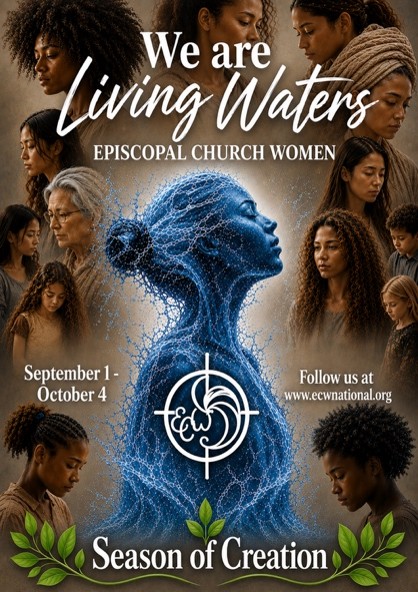
Season of CreationThe National Episcopal Church Women are hosting The Season of Creation, an annual ecumenical commemoration running from September 1 to October 4. The 2026 program centers around the theme Living Water, which unites Christians globally to pray, worship, and take action to protect the environment. Over the coming weeks, the program will explore how human beings interact with and impact physical and spiritual water sources, emphasizing that humans are interconnected with the global water cycle.

Participants are invited to engage with these lessons by sharing their own personal stories, reflections, and photographs on the ECW’s Facebook page.

Estación de la creación. Agua Viva

La Asociación Nacional de Mujeres de la Iglesia Episcopal está organizando La estación de la creación, una conmemoración ecuménica anual que se extiende desde el 1° de septiembre hasta el 4 de octubre. El programa de 2026 se centra en el tema del Agua Viva, que une a los cristianos de todo el mundo para orar, rendir culto y tomar medidas para proteger el medio ambiente. En las próximas semanas, el programa
explorará cómo los seres humanos interactúan con las fuentes de agua física y espiritual, así como el impacto que tienen sobre ellas, enfatizando que los humanos están interconectados con el ciclo del agua a nivel mundial.

Acompáñenos en Facebook y en las lecciones guiadas en el sitio web para unirnos y explorar la trayectoria del Agua Viva durante el mes de septiembre.

Season of Creation: We Are Living Waters Week 1 – September 1 – ‘see below’
Spanish

Season of Creation: We Are Living Waters – Week 2 -September 8
Spanish

Season of Creation: We Are Living Waters – Week 3 – September 15
Spanish

Season of Creation: We Are Living Waters – Week 4 – September 22
Spanish

Season of Creation: We Are Living Waters – Week 5 – September 29
Spanish

Week 1

This week’s curriculum highlights a project by artist-in-residence Kweli Kitwana, who collects water stories to examine how local waterways connect people across geographies, histories, and ancestry.

From the Book of Genesis (NRSVue):

1 When God began to create the heavens and the earth, the earth was complete chaos, and darkness covered the face of the deep, while a wind from God swept over the face of the waters.

And God said, “Let there be a dome in the midst of the waters, and let it separate the waters from the waters.” So God made the dome and separated the waters that were under the dome from the waters that were above the dome. And it was so.

And God said, “Let the waters under the sky be gathered together into one place, and let the dry land appear.” And it was so. 10 God called the dry land Earth, and the waters

20 And God said, “Let the waters bring forth swarms of living creatures, and let birds fly above the earth across the dome of the sky.” 21 So God created the great sea monsters and every living creature that moves, of every kind, with which the waters swarm and every winged bird of every kind. And God saw that it was good. 22 God blessed them, saying, “Be fruitful and multiply and fill the waters in the seas. .

26 Then God said, “Let us make humans in our image, according to our likeness, and let them have dominion over the fish of the sea and over the birds of the air and over the cattle and over all the wild animals of the earth and over every creeping thing that creeps upon the earth.”

27 So God created humans in his image, in the image of God he created them. . .

Without water, there is no creation as we have come to know it. There is no life as we have come to know it and live it.

Welcome to The Season of Creation which is an annual ecumenical commemoration that runs from September 1 to October 4. However, as part of God’s creation, this season is with us each and every day. Yet, in this time set aside to focus on creation and how we, as human beings interact and impact it, Christians worldwide unite during these weeks to pray, worship, and take action to protect the environment, God’s creation. The 2026 theme is “Living Water,” inspired by the prophet Ezekiel 47:9-12 (NRSVue):

Wherever the river goes, every living creature that swarms will live, and there will be very many fish once these waters reach there. It will become fresh, and everything will live where the river goes. 10 People will stand fishing beside the sea from Engedi to Eneglaim; it will be a place for the spreading of nets; its fish will be of a great many kinds, like the fish of the Great Sea. 11 But its swamps and marshes will not become fresh; they are to be left for salt. 12 On the banks, on both sides of the river, there will grow all kinds of trees for food. Their leaves will not wither nor their fruit fail, but they will bear fresh fruit every month, because the water for them flows from the sanctuary. Their fruit will be for food and their leaves for healing.”

As we begin this journey together, you are invited and encouraged to watch alone or in groups, a video invitation from faith leaders: https://www.youtube.com/watch?v=fnho_aeql2w

There is also a guide which includes prayers, services, and other resources that can be used during these weeks and after:

https://drive.google.com/file/d/1WeWEjt_WxyS6Ed5qD8tnRIahSMJ5SUmi/view

Each week, there will be resources provided for review and reflection on the ECW webpage and you are encouraged to join the community on our Facebook page to share those reflections: https://www.facebook.com/ecwnational. Take time to be with the information provided, to include your reflections and those who also share. Don’t rush.

Reflecting on the theme, Living Water, the Episcopal Church Women recognize the words refer to Jesus being the Living Water that spiritually sustains and heals us. In John 7:37-39 (NRSVue), he promises:

37 On the last day, the climax of the festival, Jesus stood and shouted to the crowds, “Anyone who is thirsty may come to me! 38 Anyone who believes in me may come and drink! For the Scriptures declare, ‘Rivers of living water will flow from his heart.’” 39 (When he said, “living water,” he was speaking of the Spirit, who would be given to everyone believing in him.)

In John 4:13-14 (NRSVue), Jesus contrasts this spiritual water that is him with physical water as he advises the Samaritan woman:

13 Jesus replied, “Anyone who drinks this water will soon become thirsty again. 14 But those who drink the water I give will never be thirsty again. It becomes a fresh, bubbling spring within them, giving them eternal life.”

And yet we know physical water is also important to the life and well-being of God’s creation, to include us, those created in God’s image. Therefore, during this period of reflection, we, as Episcopal Church Women, will focus on Living Waters, that we are living waters because we are comprised of water and there are various sources of water important to life on this planet with which we interact and affect. While eternal life is important, we understand it is also important to care for and nourish life as we live it in the here and now, that we care for and protect creation.

In Genesis, the human did not live until God shared her breath and as we breathe, we exchange 10-17 ounces of water with the atmosphere on a daily basis. Each time we exhale, our breath carries invisible water vapor into the air. Our bodies, on average are 60% water and our skin constantly loses invisible moisture (insensible perspiration) directly to the air, adding another 13 – 20 ounces daily. These numbers increase if we actively exercise and perspire. As we breathe and perspire, our water joins the global water cycle. Once our breath water and perspiration enter the air as gas and join with water that evaporates from oceans, lakes, plants, and other sources, it all rises to form clouds and eventually falls back to earth as rain or snow.

We are one with the waters of creation

This week we will focus on how we are one with the waters of creation. As part of this journey, I’d like to introduce you to Kweli Kitwana. Kweli is an artist, a creative and she is an Artist in Residence with MANGO for the Ocean VII International Virtual Residency! https://oceandecade.org/events/ocean-virtual-art-residency/. As part of this residency, she has used Facebook postings to share her journey. I share, with her permission, a recent edited post- https://www.facebook.com/AfricanAmericanFabrics

This week, my project moved more deeply into the physical collection of memory. I have been gathering water and water stories as part of my exploration of the ocean as a sacred witness and keeper of memory. I am thinking about water not simply as something I observe, but as something that moves, carries, connects, and transforms. My collection is beginning to include very different relationships with water.

I have received from many of you actual water and stories connected to the Arkansas River, Memphis tap water drawn from the ancient Memphis Sands aquifer, Berkeley water, and stories connected to the Ohio River, Hawaii, and the Nile River in Egypt. One story remembers a childhood creek behind an elementary school our sons attended. Another brought me the Chinese saying, “When drinking water, remember the source.”

People have described water as cleansing and calming, as something that helps them sleep, as a place to float, and as a force that can carry the body through waves. These contributions are helping me understand something important about my project: we do not have to live beside an ocean to have a relationship with it.

A person may experience water through the river behind their home, a childhood creek, rain falling in their neighborhood, a well, an underground aquifer, a lake, or the water flowing from their kitchen tap. These seemingly local waters are part of much larger hydrological systems. Rivers travel toward other rivers, estuaries, bays, and oceans. Rain rises and returns. Underground water holds traces of ancient rainfall. Water continually crosses the boundaries we use to separate places.

For people who live inland, the ocean may therefore be present in their own “backyard” through the waterways that surround and sustain them.

This expands my understanding of interconnectedness. The Pacific Ocean I encounter from Ruby (her boat) at the Berkeley Marina is not the only entry point into this work. Someone standing beside the Arkansas River or remembering a childhood creek can enter the conversation too. The Memphis Sands aquifer introduces another scale of memory, water held underground over immense periods of time. The Nile carries another geography and cultural history. A caregiver befriended at a local swimming pool is another entry point. The Ohio River story carries an especially powerful ancestral dimension through its association with ancestors navigating toward freedom from enslavement.

These waters do not carry identical histories, and I do not want to collapse them into a single story. I am interested in what happens when they are allowed to exist beside one another as individual memories within an interconnected water system.

My visit to the UC Berkeley Botanical Garden expanded this exploration further. I spent time learning about dye plants and was given plant cuttings, flowers, leaves, and roots to continue experimenting with in my studio. I am now working with Indigofera, woad, madder root, alkanna, Cota tinctoria, and Coreopsis.

I began to realize I am interested in these plants as more than sources of color. I am thinking about them as remnants and carriers of histories. Because some of these plants have traveled across continents and oceans through trade, migration, colonization, and cultural exchange. Indigo, in particular, carries a complicated history connected to colonial economies and the labor and knowledge of enslaved Africans. Other plants allow me to think more symbolically about roots, land, sunlight, survival, hidden knowledge, and the places descendants eventually make home.

As a descendant of enslaved Africans, this brings another layer to my investigation. I am asking what my ancestors carried forward when so much was taken from them. Not only trauma, but knowledge, creativity, spirituality, resilience, love, beauty, and ways of understanding the natural world.

I am beginning to map each plant into this larger story: Indigo as passage, woad as empire, madder as roots, alkanna as hidden memory, Cota as light, and Coreopsis as descendant and place. I will extract colors from these plants onto cloth and paper while preserving some of the original plant material as part of my growing archive.

Now the water and plants are beginning to come together.

I am considering how collected waters, plant dyes, earth pigments, cloth, paper, photographs, and other remnants might become material records of these relationships. A piece of cloth may hold color extracted from a plant while also carrying the story of a particular water. A bottle of water may sit beside the plant remnant and textile it helped create. The process itself can become a mapping of place, movement, ancestry, and memory.

The word “remnant” has become important to me. A remnant is what remains, but it is not necessarily something incomplete. It can contain evidence of an entire story. A root, a piece of cloth, a photograph, a bottle of collected water, a dried flower, or a stain of pigment can hold a relationship to something much larger.

This week’s work is helping me understand that my project is not about recreating the past. It is about recognizing what remains, what has traveled, what connects us, and what continues.

The creek connects to the river.
The river connects to the ocean.
The rain connects to the aquifer.
The plant connects to the land.
The pigment connects to the plant.
The remnant connects to memory.
The ancestor connects to the descendant.

And I am somewhere within all of these relationships, receiving, observing, creating, and carrying something forward.

The water carries.
The plants carry.

I carry.

We are one with the waters of creation

If you are reading this on the ECW website, you are now invited to go to the ECW Facebook https://www.facebook.com/ecwnationalpage to participate in the first week’s assignment/reflection. If you are reading this on the ECW Facebook page, then you are ready to go.

  • How did the bible verses affect how you understand water? How are you “one” with the waters of creation? What are those waters? Where do you find those waters? You might take a walk along a creek and realize your breath; your perspiration has been co-mingled with those waters. You might take a shower or turn on the tap or gather water from a well and realize you are also one with those waters. Or you must might go for a run and perspire and realize that water will join with others to form rain that will fall to the earth and replenish lakes, oceans, and aquifers or water the plants in your garden. As you dress and continue to reflect on Kweli’s writing, you realize how the fibers that form the cloth to make your clothes contains your breath, your sweat. How do you as “Living Waters” interact with other waters of creation? Share your stories past and present. Post pictures if you wish.

As you post your reflections (and pictures), take time to read what others are posting. Think about what you might have in common.

2026-08-27T13:45:47+00:00August 21st, 2026|

Season of Creation We Are Living Waters Week 2

Season of CreationThen Adonai Elohim formed the human out of the dust from the ground and God breathed into the human’s nostrils a breath of life—so the human became a living being.” (TLV)

We are Living Waters

 Let us pray.

Let the sea and everything in it roar; and the world and all its inhabitants too. Let all the rivers clap their hands. (Ps 9:7-8a)

Why do we destroy your oceans with plastic and filth knowing we are one with these waters?

Why do we destroy your oceans with plastic and filth knowing your water is needed for the life of your people?

Why, oh Lord?

The sea gave up the dead that were in it; and Death and the Grave gave up the dead that were in them, and people were judged by what they had done. (Rev. 20:13)

Amen.

When God breathed into the human, that breath had moisture – water – and that moisture, that water was shared with the human. When that human exhaled, the shared water was then shared with other living creatures. It became part of the cycle of life. That breath, that water has been shared with us and we continue to share it around the world. We are connected to each other by that water, by that breath.

We are one with the waters of creation.

We are one with each other through the waters of creation.

We are Living Waters.

 Thank you for sharing your stories, your reflections, and your pictures. As we continue to delve into our connection to and with each other through water, we will again travel around the world. Too many of us take water for granted. We turn on the tap or faucet and clean water comes out – as much as we want, for as long as we want. The water goes down the drain or if we are outside, down the sewer and then where? Whose lives are affected along the way? What life is affected along the way? All water is recycled. Clean, dirty, it doesn’t matter. Nothing new is ever created. We are in the business of recycling what God created in those six days.

While 70% of the planet is covered in water, only 2% is available to sustain life. Every living creature vies for that 2%.

Watch the following videos and then share your reflections to the questions that follow on the ECW Facebook page (https://www.facebook.com/ecwnational/). If your language is other than English, the videos have sub-titles.

Questions for Reflection:

  • Do you believe in climate change and how has it affected where you live?
  • What is the current status concerning water in the cities/countries mentioned in the videos?
  • How are the lives of children affected by the lack of clean, available water?
  • Are you aware of how much water it takes to grow the food you eat or produce the clothes you wear?
  • Do you believe water should be considered a commodity from which people make a profit? Do you purchase water?
  • As you walk or drive, do you see water being wasted?
  • Is there anything else you learned about how we use and perhaps misuse/abuse water?
  • Be sure to read and reflect on what others share.
2026-08-21T15:01:49+00:00August 21st, 2026|

Women in Healing and Theology Scholarship 2026 Winners

The National Episcopal Church Women is proud to recognize the recipients of its inaugural 2026 Graduate Scholarship Program, celebrating women who are answering God’s call through advanced study in theology and the healing professions. These exceptional scholars exemplify faithful leadership, academic excellence, and a deep commitment to serving Christ through their ministries and vocations. As the first recipients of these scholarships, they establish a meaningful legacy that reflects NECW’s commitment to investing in women whose gifts will strengthen the Church and transform communities for generations to come.

Women in Healing Ministries Scholarship Recipient

Adrienne Hubbard Adrienne Hubbard —Diocese of Olympia / Diocese of Washington (Province VIII)

Program: Entry MSN, Johns Hopkins University School of Nursing

Graduation: May 2027

Adrienne’s call to nursing emerged after the death of her godmother Kim, a “nurse, healer, and compassionate spirit,” whose legacy she seeks to carry forward. Her grief drew her back to church and into a vocation where her “path to God and path to nursing are inextricably linked.” Adrienne is active in parish life at Saint Mark’s Cathedral and Ascension & St. Agnes; serves as eucharistic minister and on the 20s/30s leadership team. She highlights intergenerational mentorship from women in caregiving professions. She plans to work as a bedside nurse in DC; long-term goals include maternal-child health policy, advocacy, and a future PhD.

Lisa Richardson Lisa Richardson —Diocese of Southwest Florida (Province IV)

Program: PhD in Art Therapy at Adler University

Graduation: May 2027

Lisa’s calling to the healing professions began through work with at-risk youth and grew into a passion for using creativity and art therapy to support emotional and spiritual wellness. She views creativity as a reflection of being made in God’s image and is committed to making expressive arts programs accessible to underserved communities.

Following a cancer diagnosis, Lisa experienced a period of deep spiritual reflection that strengthened her commitment to helping others heal through faith and creativity. Her doctoral work now focuses on developing expressive arts programs that promote mental wellness and emotional regulation.

Women in Theology Scholarship

Rev-Luz-Garces-ECWLuz María Lambis Garcés —Diocese of Colombia (Province IX)

Program: Master of Divinity, Universidad Santo Tomás

Graduation: TBD

Luz María is enrolled in a Master’s in Theology at Universidad Santo Tomás and is discerning a call to ordained ministry with a focus on pastoral accompaniment.

She serves as Women’s Coordinator for Province IX and is a regional formation leader, offering cross-cultural leadership that strengthens women’s ministries across diocesan boundaries. Her financial need is tied to tuition for a four-semester program. She articulates her vocation as a desire “to be a bridge between God and people,” reflecting a deeply rooted pastoral identity.

Susan MuellerSusan L. Mueller —Diocese of Ohio (Province V)

Program: Master of Divinity, Virginia Theological Seminary

Graduation: May 2028

Sue is pursuing an M.Div. at Virginia Theological Seminary with a call to priesthood and sacramental ministry. Her formation is grounded in justice, creation care, and a strong liturgical sensibility. She brings extensive leadership through the Diocesan and National ECW, including service as Creation Care Chair and in worship planning roles.

She writes that she has encountered Christ “in both brokenness and hope,”a theme that shapes her pastoral imagination.

Lucinda DennisLucinda Dennis —Diocese of Missouri (Province V)

Program: Master of Divinity, Virginia Theological Seminary

Graduation: May 2028

Lucinda describes a lifelong call to ordained ministry that deepened through life experiences, volunteer ministry, and spiritual discernment. After years serving in parish leadership and outreach, she felt called to fully dedicate her life to ministry and theological education. Her leadership has been shaped through Episcopal Church Women, pastoral care ministries, Eucharistic visitation, and outreach to nursing homes and homebound parishioners. She emphasizes servant leadership, compassion, and community-building, particularly through ministries developed during and after the COVID-19 pandemic. Lucinda left employment and relocated to attend seminary full time, viewing the transition as an act of faith and obedience to God’s call.

Alicia HagerAlicia Hager — Diocese of the Great Lakes (Province V)

Program: Master of Divinity, The General Theological Seminary

Graduation: May 2027

Alicia’s call to ordained ministry began through lay leadership and discernment toward the diaconate before evolving into a call to the priesthood. After years of formation, delayed by diocesan transitions and the pandemic, she was ordained in 2022 and now leads a growing parish community. She is pursuing her M.Div. to strengthen her formation and expand future opportunities for diocesan and parish leadership. Her ministry is deeply shaped by the women of the Episcopal Church who mentored and supported her through parish life, choir, and outreach ministries. Alicia describes her leadership style as pastoral and relational, centered on guiding and caring for her congregation with compassion and authenticity.

Susanne O’ DaySusanne O’ Day —Diocese of Georgia (Province IV)

Program: Master of Divinity, General Theological Seminary

Graduation: May 2028​

Her application reflected a lifelong call to ordained ministry that has grown through parish leadership, children’s ministry, preaching, and women’s Bible studies. She is passionate about Christian formation, pastoral care, and creating welcoming communities where women, children, and those on the margins are fully seen, valued, and empowered. The committee was particularly impressed by her thoughtful vocational discernment, demonstrated leadership, and commitment to serving the Church through compassionate, inclusive ministry.​ Suzanne is a dedicated church leader whose theological studies support an ongoing commitment to spiritual formation, service, and leadership within the Episcopal Church.

2026-07-31T16:24:21+00:00July 31st, 2026|

President’s Report June 2026

Lisa BortnerA Season of Faith in Action

Dear ECW Sisters and Friends,

As I reflect on the first months of 2026 and our recent National ECW Board meeting in Providence, Rhode Island, I am filled with gratitude for the faithful witness of Episcopal Church Women across our Church. This season has been marked by prayer, advocacy, service, planning, and renewed connection—reminding me once again that ECW continues to be a vibrant and vital ministry grounded in faith and action.

Throughout January, February, March, and April, I continued hosting Morning Prayer on Facebook Live along with others, creating intentional spaces for reflection, encouragement, and community. These moments of prayer have served as an important reminder that our ministry must always begin with listening for the guidance of the Holy Spirit. Whether we are serving locally, advocating globally, or tending to the work of governance, we do so rooted in prayer.

One of the most meaningful experiences of this season was participating in the 70th session of the United Nations Commission on the Status of Women. Gathering alongside women and leaders from around the world was both inspiring and sobering as we explored issues surrounding justice, equality, and dignity for women and girls. Episcopal Church Women were present not only as observers, but as active participants and advocates.

A particular highlight was our National ECW virtual parallel event, “Raising Awareness for Missing and Murdered Indigenous Women.” This powerful presentation reflected our commitment to advocacy, education, and justice while bringing attention to the ongoing crisis impacting Indigenous communities. I remain deeply grateful to everyone who contributed their gifts and leadership to this important work. The Board later reaffirmed this commitment during our Providence meeting by approving additional efforts to increase the diversity of our Social Justice Committee and strengthen our MMIW advocacy initiatives.

This spring also brought opportunities for collaboration across the wider Church. Conversations continued through the Episcopal Indigenous Justice Roundtable, NGO Commission on the Status of Women gatherings, Creation Care initiatives, International Anglican Women’s Network and General Convention and Triennial planning. Completing Climate Ambassador certification was especially meaningful as we continue to integrate environmental justice into our shared mission.

Communication and connection remain central priorities. Alongside our Second Vice President and website editor, work continues to strengthen the National ECW’s digital presence and communications infrastructure. This was especially important in supporting the virtual platform used during the UN Commission on the Status of Women event.

One of the greatest blessings of these past months has been time spent with women across the Church. I had the privilege of speaking and presenting in Springfield, Western North Carolina, Chicago, Province VIII, Mentone, Alabama and other gatherings. These visits are always deeply life-giving and remind me of the faithfulness, creativity, and commitment that define ECW ministry at every level. It was also encouraging to support the beginnings of a new ECW chapter at St. Cecilia’s in Round Top, Texas, as well as efforts to restart the Diocese of Texas ECW.

Our recent National ECW Board meeting in Providence, Rhode Island, hosted by Province I, beautifully reflected the spirit of service and fellowship that defines this organization. One of the most moving moments of the gathering was attending Church Beyond the Walls in Burnside Park. Despite cold drizzle and gray skies, the bilingual outdoor Eucharist radiated warmth, welcome, and joy. Following worship, Board members assisted in serving meals and distributing bread and clothing to those in need—a powerful reminder that ministry happens not only in meeting rooms, but also in direct service to our neighbors.

The hospitality extended by the Diocese of Rhode Island ECW and St. David’s on the Hill was extraordinary. Sharing fellowship, meals, worship, and conversation with women from across the region was a gift. We also concluded our gathering worshipping together at Grace Episcopal Church in Providence, giving thanks for the ministry entrusted to us.

Much of our Board meeting focused on preparations for the 2027 Triennial, which will be held in Phoenix, Arizona, from July 3–8, 2027, under the theme Women at the Well: Faith in Action. Planning is well underway as we prepare workshops, worship opportunities, a Share Fair, leadership elections, and the Distinguished Woman’s Luncheon. We are especially excited about opportunities for fellowship, learning, and celebrating the ministries happening throughout the Church.

The Board also approved several significant actions during our meeting, including grants and donations supporting Church Beyond the Walls, dioceses impacted by natural disasters in Hawaii and Nebraska, sponsorship for the Big Provincial V Gathering, and the establishment of start-up grants for parish ECWs. We also committed support for the Prayer Vigil on the Doctrine of Discovery and approved the adjusted Triennial budget.

As I look back on these months, I see a season defined by faithful movement—showing up in spaces both local and global, tending carefully to governance and stewardship, advocating for justice, and continuing to strengthen the ministry of Episcopal Church Women. Everywhere I travel, I am reminded that ECW is alive with compassion, creativity, resilience, and hope.

Thank you for the countless ways you continue to serve Christ and the Church through Episcopal Church Women. It is a privilege to serve alongside each of you as together we continue living out our call to faith in action.

Faithfully,

Lisa Bortner

2026-05-27T14:09:28+00:00May 25th, 2026|

President’s Report May 2026

Lisa BortnerPresident’s Report to the National ECW Board
Reporting Period: January–April 2026

This season has been filled with meaningful opportunities for prayer, leadership, advocacy, and connection across the Church and beyond. I remain deeply grateful for the ways in which this Board continues to support and engage the mission and ministry of Episcopal Church Women.

A steady rhythm of spiritual leadership has grounded my work during this time. Through hosting Morning Prayer on Facebook Live across several weeks in January, February, March, and April, I have sought to create space for reflection, encouragement, and community. These gatherings continue to be a reminder that our work must always be rooted in prayer and guided by the Holy Spirit.

In the area of governance and administration, an important action taken following our January meeting was the communication of the Board’s decision to suspend distributions from all National ECW Trust Funds for the 2026 calendar year. In that same correspondence, I shared the Board’s resolution regarding the Wright Legacy Trust Fund (#630). After careful consideration, the Board determined that changes to the United Thank Offering’s bylaws—expanding leadership eligibility beyond women—mean that it no longer meets the original intent of the fund, which was designated for the work of the Woman’s Auxiliary Division. As a result, we have requested that our Executive Council revoke the current allocation arrangement so that the trust may be fully directed to the National ECW. Our resolution is now being reviewed by Executive Council’s Finance Committee. In addition, I met with DFMS leadership to continue conversations around our accounting systems as well as new DFMS systems that are to be used for travel, reimbursements and payments.

Communication and infrastructure have also been a focus during this time. I met regularly with our 2nd Vice President and website/editor to address ongoing communications needs and to strengthen our digital presence. Much work went into the Whova platform that was used by the NGO Commission on the Status of Women to host our virtual event focusing on Missing and Murdered Indigenous Women.

A significant highlight of this reporting period was my participation in the 70th session of the United Nations Commission on the Status of Women. This experience was both inspiring and sobering, as global leaders gathered to address the theme of ensuring and strengthening access to justice for all women and girls. Our presence there as Episcopal Church Women was a powerful witness. We began the week in fellowship, hosting a welcome gathering for our delegation and guests, and continued with worship, relationship-building, and engagement in both official UN sessions and parallel events.

One of the most meaningful contributions of the National ECW during this time was our virtual parallel event, “Raising Awareness for Missing and Murdered Indigenous Women.” This presentation brought critical attention to an ongoing crisis and reflected our commitment to advocacy, education, and justice. I am deeply thankful to all who contributed their time and leadership to make this event impactful.

Much of this season has also been shaped by engagement with the wider Church and global partners. I participated in ongoing conversations through the Episcopal Indigenous Justice Roundtable, as well as gatherings connected to the NGO Commission on the Status of Women. Hosting the Province Presidents and Representatives meeting in February provided an important opportunity to listen, collaborate, and strengthen relationships across our provinces.

Throughout this period, I have also remained engaged in the life of The Episcopal Church through webinars, panel discussions, and Creation Care initiatives. Completing the Climate Ambassador certification was a particularly meaningful step, equipping me to further integrate environmental justice into our shared work.

Equally important has been my connection with diocesan ECW groups. I have had the privilege of serving as a speaker and presenter at several diocesan gatherings, including in Springfield, Western North Carolina, Chicago, and Province VIII. These moments of being present with women across the Church are deeply life-giving and affirm the strength, faith, and dedication that continue to define ECW at every level. It was also a joy to support the beginnings of a new ECW chapter at St. Cecilia’s in Round Top, Texas as well as a group that hope to restart the Diocese of Texas ECW—an encouraging sign of renewal and growth.

In addition to these engagements, I have remained active in the work of our committees, including Finance, Bylaws, and Triennial planning, as well as in conversations supporting General Convention preparations.

Taken together, these months reflect a season of faithful movement—of showing up in spaces both local and global, of tending to the responsibilities of governance, and of continuing to lift up the voices and concerns of women. The work of Episcopal Church Women remains vital, and it is a privilege to serve alongside each of you as we carry this mission forward.

Respectfully submitted,
Lisa Bortner
President, National Episcopal Church Women


2026-05-02T13:02:24+00:00May 2nd, 2026|

Presidents Report April 2026

I’m honored to share a brief reflection on what it was like for the National Episcopal Church Women to participate in CSW70.

Participating was both inspiring, energizing, and exhausting. For National ECW, it was an opportunity not only to listen and learn, but also to actively contribute to important global conversations—particularly those that intersect with faith, advocacy, and justice.

One of the highlights of our participation was our own parallel event titled “Advocating for Missing and Murdered Indigenous Women,” which took place virtually on March 11. I’m pleased to share that this event was a meaningful success. We created a space for education, reflection, and advocacy around the crisis of Missing and Murdered Indigenous Women—often referred to as MMIW. The conversation was powerful, informative, and deeply moving, and it reinforced the importance of continuing this work beyond CSW70.

For those who were unable to attend, the recording of this event is now available on our YouTube channel, National Episcopal Church Women. I encourage everyone to watch, share, and continue learning.

While CSW70 has concluded, our work certainly has not. There are many ways Episcopalians can stay connected with National ECW and continue supporting our efforts in parishes and dioceses across the country.

For those who feel called to support the cause of Missing and Murdered Indigenous Women in a tangible way, we offer an opportunity to give. Donations can be made online through our website. For a contribution of $30, donors will receive an MMIW t-shirt, with all proceeds going directly toward advocacy efforts supporting this critical cause.

Additionally, we invite everyone to participate in the Red Dress Movement, observed each year on May 5. This powerful movement raises awareness and honors the lives of Indigenous girls, women and two-spirit people who have been lost. Participation can take many forms, and we encourage involvement at the parish and Diocesan levels. We encourage our ECW sisters to wear red on May 5, hang red dresses in windows or trees or on their porches, support local indigenous-led events, and educate others on MMIW issues. Women can gather for prayer or hold a prayer vigil on May 5. They can also host gatherings to view our MMIW presentation on the National ECW YouTube channel. Social media is also a great way to share stories and information using hashtags like #RedDressDay and #MMIW.

In closing, CSW70 was not just an event—it was a catalyst. It reminded us that our voices matter, our actions matter, and together, we can and must continue to advocate for justice, healing, and change. We have come along way in gaining rights for girls and women, but as CSW70 made very clear, we still have many obstacles to overcome, and it will take a concerted effort on the part of all women to make sure we don’t continue to slide backwards rather than moving forward. I encourage everyone to talk to their church leaders regarding this. Talk to your mothers and fathers. Talk to your husbands. Talk to your children and most importantly talk to your elected officials. Women’s justice is everyone’s justice.

Thank you.

Lisa Bortner

NECW President 2024 – 2027

2026-04-02T19:52:51+00:00April 2nd, 2026|
Go to Top