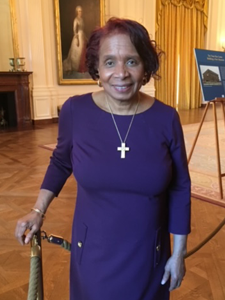
First Nations Kitchen

Rev. Robert Two Bulls
The story of First Nations Kitchen has its roots in the late 1990s with the Reverend Melanie Spears, her husband George and family, and the congregation of All Saints Indian Mission. During this time Path Crossing conferences were being held. Path Crossing encouraged the exploration of cross-cultural partnerships, linking predominantly Native American congregations with mostly Anglo congregations in the United States.
Through the Right Rev. Mark McDonald, a connection was made between All Saints and St. Paul’s, Indianapolis. Mother Melanie was intent on building relationships, tiospaye, community, as opposed to transactional partnerships. All Saints folks hosted St. Paul’s folks in their homes. The invitation from Mother Melanie was, “Come be part of our family.” This was the thread throughout the partnering that led people from both churches, as well as those of St. John the Baptist and The Cathedral of St. Mark (both in Minneapolis) to work together, hands on, in a Spirit-led process of renovating the church.
Afterward, a question was posed: “What would you like to do if you could have something here?” The answer that came: “Open a soup kitchen.” The need for a feeding program in the community was apparent. In time a commercial kitchen was built, enabling the beginning of such a ministry. The space was beautifully prepared, and the seeds were planted. Mother Melanie had to take early medical retirement in 2000 which halted the next steps, but at the time she recounts having “a vision of a Native man coming to the church… a person who was supposed to be there.”
When the Reverend Robert Two Bulls visited and interviewed at All Saints years later the parishioners expressed their hopes that a feeding ministry would begin and become sustainable. This spoke to Father Robert, as he noted, “Feeding and giving water to the hungry and thirsty, welcoming the stranger, are both a Gospel mandate and a Lakota practice.” Matthew 25:35-36 reads, “For I was hungry, and you gave me food, I was thirsty and you gave me something to drink, I was a stranger and you welcomed me, I was naked and you gave me clothing, I was sick and you took care of me, I was in prison and you visited me.”
The Reverend Robert Two Bulls accepted the call to serve as the Vicar of All Saints and the Missioner for the Department of Indian Work in the Episcopal Church in Minnesota (ECMN). Detailed and careful planning ensued, and First Nations Kitchen (FNK) began serving on All Saints Day, November 1, 2008. Father Robert came up with the name First Nations Kitchen, noting that we live close to the Canadian border and the term “First Nations” is used to describe the indigenous peoples of Canada. These words capture the fact that the indigenous peoples here in the U.S. also hail from sovereign nations and further emphasize the foods that we serve: indigenous and organic.
FNK is a justice-focused, Gospel based ministry led by indigenous people for indigenous people. A primary intent is to make high-quality, fresh, organic food accessible to all and to do this in a setting where cultural empowerment and radical hospitality are centered. Serving venison, bison, turkey, lake and river fish, and wild rice, is a commitment to making meals which hearken to the ancestral foods of the indigenous peoples to this region: Dakota and Anishinabe. This decision is also a response to the health crises in the Native American communities. Working to create a safe and joyful space where all are welcomed led FNK to serving neighbors at tables on dishes as if in a restaurant or family home. Volunteers take turns sitting to eat with guests and getting to know one another.
How does a mission church take on such a huge service within the community and sustain it—relationships and community building. Partnerships were formed with churches, schools, secular groups, and a wide range of individuals. These partnerships provided volunteers committing to serving on Sundays. By 2019, FNK had 27 active partners. Then came COVID-19. To this point, FNK had not missed serving a Sunday meal since opening. When the pandemic hit FNK halted services for two months. Planning began in earnest for how to safely change our services, by greatly reducing volunteer numbers, instituting clear and consistent COVID safety practices, simplifying our service, and moving the sharing of foods outside. FNK reopened first with distributing bagged organic produce, then adding To Go meals. To date all food is being served outside our building, rain, snow or shine, whatever the season. During the height of COVID-19 many partners had to step back or suspend their commitment. By 2021 FNK had five active partners. At the time of this writing they have increased to eight and believe they will see newer and returning groups and volunteers.
We are grateful for our relationships in our community and beyond.
Ritchie Two Bulls (she/her/hers)
Outreach Coordinator, First Nations Kitchen
An Outreach of All Saints Indian Mission
firstnationskitchen.org
612-790-8482
El Archidiácono Louis Maberry de la Diócesis Episcopal del Oeste de Luisiana y asignado a la iglesia Episcopal de San Jorge ubicado en la ciudad de Bossier en el estado de Luisiana.
La Villa de Babilonia en Long Island, New York, es notoria por ser un lugar seguro, amigable y hermoso para habitar. Babilonia es la costa del sur del condado Suffolk en Long Island, haciéndola así en un lugar bien popular durante las vacaciones de verano, pero el área del centro pone en despliegue restaurantes de lujo, un teatro histórico, al igual que bicicletas que mantienen a la gente oriunda de la zona y a los visitantes ocupados todo el año. La Iglesia Episcopal de Cristo ha surgido entre las casas de múltiples pisos y pintorescos parques desde 1930.
En retrospectiva, Diane dice que el conocimiento que el equipo ha reunido de esa consulta y debate iniciales dentro de la comunidad fue invaluable para el ministerio. Los miembros de la comunidad tenían una plataforma para discutir desavenencias, y los voluntarios fueron capaces de conseguir soluciones sin menoscabar la integridad del ministerio. Esto fue vital para el equipo a la hora de realizar su trabajo porque podían escuchar atentamente las preocupaciones de las personas afectadas y responder de manera acorde. Este método de escuchar los retos e implementar soluciones concretas es ahora un elemento fundamental para el trabajo de “Nutriendo a Babilonia.”
La Iglesia Episcopal de La Gracia en Muncie, Indiana, ha sido ubicada en el sureste del Centro de la ciudad de Muncie por los últimos 140 anos. A través de los años, el área alrededor de la Iglesia ha cambiado, y la Iglesia de La Gracia también, tras participar en varios proyectos vecinales y al generar muchas iniciativas de voluntariado, incluyendo su programa de alimentación, la “Gracia que Alberga”, la cual comenzó en el año 2008. Antes de la Pandemia, sirvieron más de 100 comidas caceras todos los domingos. Cuando la Pandemia empeoro, no fueron capaces de continuar administrando dichas comidas en persona, pero ello no se interpuso en la repartición de estas. Los voluntarios entregaban una ración de comida cacera cada domingo en un saco el cual incluía un emparedado para ingerir en horas posteriores como merienda, al igual que una botella de agua para su hidratación debida. El promedio era de alrededor de 70 comidas por semana y para ello se necesitaba un personal de seis a diez voluntarios ayudando todos los domingos. El Reverendo y Doctor Paul Jacobson, el rector de la iglesia, cree que la reapertura de la parroquia para la comunidad es el trabajo más importante que la parroquia efectúa.
Nuestra iglesia está pasando por cambios. El primero de ellos es que nos estamos adaptando a estar en el medio de una pandemia, y el siguiente de los cambios, es que pasamos por un proceso de transición para darle la bienvenida a la nueva sacerdotisa. Nuestra nueva sacerdotisa apoya el ministerio de Mujeres de la Iglesia Episcopal y conmina al comité del Obispo junto al Grupo de Mujeres de la Iglesia Episcopal a continuar en la búsqueda mas allá de la misma iglesia para servir a la comunidad y sus necesidades. El Ministerio de Mujeres de la Iglesia Episcopal consiste en un grupo pequeño de mujeres dedicadas a esa tarea de manera exacta.