
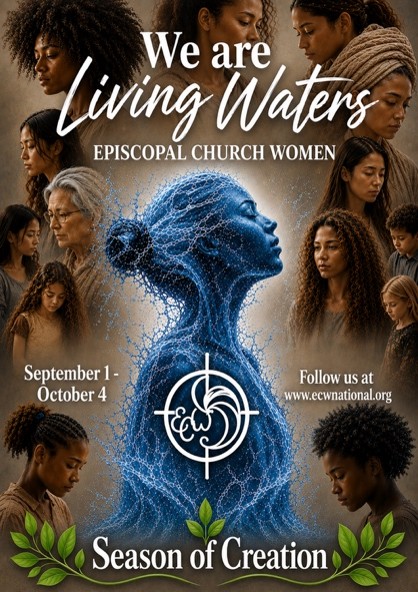
 The National Episcopal Church Women are hosting The Season of Creation, an annual ecumenical commemoration running from September 1 to October 4. The 2026 program centers around the theme “Living Water,” which unites Christians globally to pray, worship, and take action to protect the environment. Over the coming weeks, the program will explore how human beings interact with and impact physical and spiritual water sources, emphasizing that humans are interconnected with the global water cycle.
To launch the multi-week initiative, the ECW provides participants with video invitations, a comprehensive resource guide, and weekly reflection materials. Participants are invited to engage with these weekly lessons by sharing their own personal stories, reflections, and photographs on the organization’s community Facebook page.
I will put links to the other weeks here:
Week 1 – September 1
Spanish link
Week 2 -September ?
Spanish link
Week 3 – September ?
Spanish link
Week 4 – September ?
Spanish link
Week 5 – October 4
Spanish link
Week 1
This week’s curriculum highlights a project by artist-in-residence Kweli Kitwana, who collects water stories to examine how local waterways connect people across geographies, histories, and ancestry
From the Book of Genesis (NRSVue):
1 When God began to create the heavens and the earth, 2 the earth was complete chaos, and darkness covered the face of the deep, while a wind from God swept over the face of the waters.
6 And God said, “Let there be a dome in the midst of the waters, and let it separate the waters from the waters.” 7 So God made the dome and separated the waters that were under the dome from the waters that were above the dome. And it was so.
9 And God said, “Let the waters under the sky be gathered together into one place, and let the dry land appear.” And it was so. 10 God called the dry land Earth, and the waters
20 And God said, “Let the waters bring forth swarms of living creatures, and let birds fly above the earth across the dome of the sky.” 21 So God created the great sea monsters and every living creature that moves, of every kind, with which the waters swarm and every winged bird of every kind. And God saw that it was good. 22 God blessed them, saying, “Be fruitful and multiply and fill the waters in the seas. .
26 Then God said, “Let us make humans in our image, according to our likeness, and let them have dominion over the fish of the sea and over the birds of the air and over the cattle and over all the wild animals of the earth and over every creeping thing that creeps upon the earth.”
27 So God created humans in his image, in the image of God he created them. . .
Without water, there is no creation as we have come to know it. There is no life as we have come to know it and live it.
Welcome to The Season of Creation which is an annual ecumenical commemoration that runs from September 1 to October 4. However, as part of God’s creation, this season is with us each and every day. Yet, in this time set aside to focus on creation and how we, as human beings interact and impact it, Christians worldwide unite during these weeks to pray, worship, and take action to protect the environment, God’s creation. The 2026 theme is “Living Water,” inspired by the prophet Ezekiel 47:9-12 (NRSVue):
9 Wherever the river goes, every living creature that swarms will live, and there will be very many fish once these waters reach there. It will become fresh, and everything will live where the river goes. 10 People will stand fishing beside the sea from Engedi to Eneglaim; it will be a place for the spreading of nets; its fish will be of a great many kinds, like the fish of the Great Sea. 11 But its swamps and marshes will not become fresh; they are to be left for salt. 12 On the banks, on both sides of the river, there will grow all kinds of trees for food. Their leaves will not wither nor their fruit fail, but they will bear fresh fruit every month, because the water for them flows from the sanctuary. Their fruit will be for food and their leaves for healing.”
As we begin this journey together, you are invited and encouraged to watch alone or in groups, a video invitation from faith leaders: https://www.youtube.com/watch?v=fnho_aeql2w
There is also a guide which includes prayers, services, and other resources that can be used during these weeks and after:
https://drive.google.com/file/d/1WeWEjt_WxyS6Ed5qD8tnRIahSMJ5SUmi/view
Each week, there will be resources provided for review and reflection on the ECW webpage and you are encouraged to join the community on our Facebook page to share those reflections: https://www.facebook.com/ecwnational. Take time to be with the information provided, to include your reflections and those who also share. Don’t rush.
Reflecting on the theme, Living Water, the Episcopal Church Women recognize the words refer to Jesus being the Living Water that spiritually sustains and heals us. In John 7:37-39 (NRSVue), he promises:
37 On the last day, the climax of the festival, Jesus stood and shouted to the crowds, “Anyone who is thirsty may come to me! 38 Anyone who believes in me may come and drink! For the Scriptures declare, ‘Rivers of living water will flow from his heart.’” 39 (When he said, “living water,” he was speaking of the Spirit, who would be given to everyone believing in him.)
In John 4:13-14 (NRSVue), Jesus contrasts this spiritual water that is him with physical water as he advises the Samaritan woman:
13 Jesus replied, “Anyone who drinks this water will soon become thirsty again. 14 But those who drink the water I give will never be thirsty again. It becomes a fresh, bubbling spring within them, giving them eternal life.”
And yet we know physical water is also important to the life and well-being of God’s creation, to include us, those created in God’s image. Therefore, during this period of reflection, we, as Episcopal Church Women, will focus on Living Waters, that we are living waters because we are comprised of water and there are various sources of water important to life on this planet with which we interact and affect. While eternal life is important, we understand it is also important to care for and nourish life as we live it in the here and now, that we care for and protect creation.
In Genesis, the human did not live until God shared her breath and as we breathe, we exchange 10-17 ounces of water with the atmosphere on a daily basis. Each time we exhale, our breath carries invisible water vapor into the air. Our bodies, on average are 60% water and our skin constantly loses invisible moisture (insensible perspiration) directly to the air, adding another 13 – 20 ounces daily. These numbers increase if we actively exercise and perspire. As we breathe and perspire, our water joins the global water cycle. Once our breath water and perspiration enter the air as gas and join with water that evaporates from oceans, lakes, plants, and other sources, it all rises to form clouds and eventually falls back to earth as rain or snow.
We are one with the waters of creation
This week we will focus on how we are one with the waters of creation. As part of this journey, I’d like to introduce you to Kweli Kitwana. Kweli is an artist, a creative and she is an Artist in Residence with MANGO for the Ocean VII International Virtual Residency! https://oceandecade.org/events/ocean-virtual-art-residency/. As part of this residency, she has used Facebook postings to share her journey. I share, with her permission, a recent edited post- https://www.facebook.com/AfricanAmericanFabrics
This week, my project moved more deeply into the physical collection of memory. I have been gathering water and water stories as part of my exploration of the ocean as a sacred witness and keeper of memory. I am thinking about water not simply as something I observe, but as something that moves, carries, connects, and transforms. My collection is beginning to include very different relationships with water.
I have received from many of you actual water and stories connected to the Arkansas River, Memphis tap water drawn from the ancient Memphis Sands aquifer, Berkeley water, and stories connected to the Ohio River, Hawaii, and the Nile River in Egypt. One story remembers a childhood creek behind an elementary school our sons attended. Another brought me the Chinese saying, “When drinking water, remember the source.”
People have described water as cleansing and calming, as something that helps them sleep, as a place to float, and as a force that can carry the body through waves. These contributions are helping me understand something important about my project: we do not have to live beside an ocean to have a relationship with it.
A person may experience water through the river behind their home, a childhood creek, rain falling in their neighborhood, a well, an underground aquifer, a lake, or the water flowing from their kitchen tap. These seemingly local waters are part of much larger hydrological systems. Rivers travel toward other rivers, estuaries, bays, and oceans. Rain rises and returns. Underground water holds traces of ancient rainfall. Water continually crosses the boundaries we use to separate places.
For people who live inland, the ocean may therefore be present in their own “backyard” through the waterways that surround and sustain them.
This expands my understanding of interconnectedness. The Pacific Ocean I encounter from Ruby (her boat) at the Berkeley Marina is not the only entry point into this work. Someone standing beside the Arkansas River or remembering a childhood creek can enter the conversation too. The Memphis Sands aquifer introduces another scale of memory, water held underground over immense periods of time. The Nile carries another geography and cultural history. A caregiver befriended at a local swimming pool is another entry point. The Ohio River story carries an especially powerful ancestral dimension through its association with ancestors navigating toward freedom from enslavement.
These waters do not carry identical histories, and I do not want to collapse them into a single story. I am interested in what happens when they are allowed to exist beside one another as individual memories within an interconnected water system.
My visit to the UC Berkeley Botanical Garden expanded this exploration further. I spent time learning about dye plants and was given plant cuttings, flowers, leaves, and roots to continue experimenting with in my studio. I am now working with Indigofera, woad, madder root, alkanna, Cota tinctoria, and Coreopsis.
I began to realize I am interested in these plants as more than sources of color. I am thinking about them as remnants and carriers of histories. Because some of these plants have traveled across continents and oceans through trade, migration, colonization, and cultural exchange. Indigo, in particular, carries a complicated history connected to colonial economies and the labor and knowledge of enslaved Africans. Other plants allow me to think more symbolically about roots, land, sunlight, survival, hidden knowledge, and the places descendants eventually make home.
As a descendant of enslaved Africans, this brings another layer to my investigation. I am asking what my ancestors carried forward when so much was taken from them. Not only trauma, but knowledge, creativity, spirituality, resilience, love, beauty, and ways of understanding the natural world.
I am beginning to map each plant into this larger story: Indigo as passage, woad as empire, madder as roots, alkanna as hidden memory, Cota as light, and Coreopsis as descendant and place. I will extract colors from these plants onto cloth and paper while preserving some of the original plant material as part of my growing archive.
Now the water and plants are beginning to come together.
I am considering how collected waters, plant dyes, earth pigments, cloth, paper, photographs, and other remnants might become material records of these relationships. A piece of cloth may hold color extracted from a plant while also carrying the story of a particular water. A bottle of water may sit beside the plant remnant and textile it helped create. The process itself can become a mapping of place, movement, ancestry, and memory.
The word “remnant” has become important to me. A remnant is what remains, but it is not necessarily something incomplete. It can contain evidence of an entire story. A root, a piece of cloth, a photograph, a bottle of collected water, a dried flower, or a stain of pigment can hold a relationship to something much larger.
This week’s work is helping me understand that my project is not about recreating the past. It is about recognizing what remains, what has traveled, what connects us, and what continues.
The creek connects to the river.
The river connects to the ocean.
The rain connects to the aquifer.
The plant connects to the land.
The pigment connects to the plant.
The remnant connects to memory.
The ancestor connects to the descendant.
And I am somewhere within all of these relationships, receiving, observing, creating, and carrying something forward.
The water carries.
The plants carry.
I carry.
We are one with the waters of creation
If you are reading this on the ECW website, you are now invited to go to the ECW Facebook https://www.facebook.com/ecwnationalpage to participate in the first week’s assignment/reflection. If you are reading this on the ECW Facebook page, then you are ready to go.
- How did the bible verses affect how you understand water? How are you “one” with the waters of creation? What are those waters? Where do you find those waters? You might take a walk along a creek and realize your breath; your perspiration has been co-mingled with those waters. You might take a shower or turn on the tap or gather water from a well and realize you are also one with those waters. Or you must might go for a run and perspire and realize that water will join with others to form rain that will fall to the earth and replenish lakes, oceans, and aquifers or water the plants in your garden. As you dress and continue to reflect on Kweli’s writing, you realize how the fibers that form the cloth to make your clothes contains your breath, your sweat. How do you as “Living Waters” interact with other waters of creation? Share your stories past and present. Post pictures if you wish.
As you post your reflections (and pictures), take time to read what others are posting. Think about what you might have in common.