
ECW Women Articles-Poems-Announcements

Miriam

MiriamOne of the books on the shelves in my childhood bedroom that I shared with my younger sister was A Little Golden Book: Bible Stories of Boys and Girls. Here the children of the Hebrew Scriptures came alive – Rebekah at the well, Joseph and his dreams, Samuel the Lord’s child, David the shepherd, and Miriam the good sister. Each child had an encounter that, knowingly or unknowingly, brought them closer to God.

The Book of Exodus begins with the bad times that had come to the children of Israel. To stop the ever-increasing number of Israelites in his land, the Egyptian Pharaoh wanted all boy babies killed. A Levite couple, Jochebed and Amram, had a son, and his mother hid him for three months. When she could not hide him any longer, she laid the baby in a covered basket of bulrushes and put the little boat among the reeds by the river bank. The baby’s big sister Miriam stood at a distance to watch over him. Pharaoh’s daughter found the baby, and saying she needed someone to care for the child, Miriam stepped forward and said, “Shall I go and get you a nurse from the Hebrew women to nurse the child for you?” not revealing that she would get her own mother, the mother of the baby. Pharaoh’s daughter said to Jochebed, “Take this child and nurse it for me and I will give you your wages.” So the happy mother had her baby back. Because his sister Miriam had watched over him, the boy grew up safe and sound at home, and when he was older, this boy Moses was educated in the Pharaoh’s palace and became the greatest leader his people knew.

Miriam’s role as big sister did not end in the simple tale of one sibling looking after another. She became a leader-prophet of the women of Israel. After crossing the Red Sea, following the great song which her brother Moses sang in honor of all Israel, Miriam organized the women in response, with “tambourines and with dancing”. “Sing to the Lord, for he has triumphed gloriously, horse and rider he has thrown into the sea.” The singing of women in ancient times gave expression to war, battle, and miracle. It is believed that the Song of Moses was actually composed by Miriam to articulate and summarize the historical experience of escaping the Pharaoh’s chariots, and also to prepare the people to cope with the forthcoming challenges. And so, Miriam was a herald; she prepared the people for what was to come following the crossing of the Red Sea. She had been the guardian of the vision; having watched over her baby brother, perhaps knowing even then that there was greatness ahead. In the wilderness she was the guardian of the vision that was to be, a new home for their people. She was, in childhood and in adulthood, the big sister who watches and worries and prepares for the future.

Miriam wasn’t a perfect big sister. Who in Hebrew Scriptures, after all, is perfect? Who of us is perfect? She and her other brother, Aaron, criticized Moses and resented his authority. “Has the Lord spoken only through Moses? Has He not spoken through us also?” The Lord called the three into a meeting, and at the end of it, Miriam only (not Aaron or Moses) was plagued with leprosy. Because of Moses’ and Aaron’s pleas, the Lord allowed her leprosy to disappear after her seven days of banishment from the camp. In a lovely touch of compassion, the people did not journey until she was brought into the camp again. She lived on, and as tradition tells, became a mother and the forebear of kings.

We Episcopal Church Women are the big sisters of the church. We are women at any age who help others find greatness and find in ourselves the greatness to lead. As some of us look to the future and to the younger women of the church accomplishing wonderful things, we can be their big sisters, watching out for them and accompanying them on their journey. We who are younger can learn from the wisdom of the women around us and know we are never alone in all the works we do. Together we are members of a women’s chorus. We give expression to the concerns of God’s people and we sing not as a call to war and battle but to peace and justice, and always to the miracles of our God. We are sisters to each other.

During the first 2 weeks of December, I will be on Pilgrimage to the Holy Land. This is my second pilgrimage, and because of Lindsay’s book, I will be looking through new eyes, through the eyes of the women who lived in the land and who spoke at the ancient sites I will see.

++++ Coming December 15th ++++

Chapter 26: Elizabeth and Mary, the mother of Jesus

Content provided by Author Lindsay Hardin Freeman

Illustration: Claire Elam
2020-05-22T18:11:16+00:00November 30th, 2015|

Forgiveness

God is with you at this time of trial.

The fabric has been torn but the weavers are among us. We need only to allow them to begin to weave and make us whole again.

A patch is often stronger than the hole that it fills.

Let us all learn what is important, What is our mission both corporately and individually, How the cloth  can be added to with softness and strength, With color of diversity and pastel of unity.

Let us see the Holy Spirit present in the threads to make the fabric whole, Knowing each thread by name, by color, by strength, And let the fabric be offered to God in thanksgiving for the fabric of life of which we are all apart.

From “Women’s Uncommon Prayers” Submitted by Connie Ott

2020-05-20T14:12:17+00:00November 30th, 2015|

Empowerment

Empower me

To be a bold participant,

Rather than a timid saint in waiting,

In the difficult ordinariness of now;

To exercise the authority of honesty, rather than to defer power,

Or deceive to get it;

To influence someone for justice,

Rather than impress anyone for gain;

And, by grace, to find treasures of joy,

Of friendship, of peace hidden in fields

Of the daily you give me to plow.

From “Wrestling the Light” by Ted Loder Submitted by Linda Guest

2020-05-20T14:16:55+00:00November 29th, 2015|

Dignity

Will you respect the dignity of every human being? – the final question presented to candidates for Holy Baptism in our Episcopal Church. And always the final question to each of us every time we renew our Baptismal vows.

As we enter this Advent season in the church, we look forward to the coming again of Jesus into our midst – Jesus the Prince of Peace, the one who bestows justice, the one who instills and honors dignity.

And I think of Elizabeth, mother of John the Baptist. Elizabeth, barren, and aging and most likely dismissed and disrespected for years. I think of her despair, her embarrassment, her humiliation in a world where the meaning and purpose of a woman’s life was for this alone – to give birth in a time and place where men defined and ruled her life. So I share with you some thoughts about Elizabeth from “Soul Sisters: Women in Scripture Speak to Women Today” by Edwina Gately and Louis Glanzman.

“How did it feel, Elizabeth, to hear… the whispers of the women – your sisters – trapped too in a system encircling them in iron boundaries of appropriate behavior? Did you sense their pity as the glanced your way… Did you flinch, Elizabeth, before your husband’s eyes… Did you feel a Defect, Elizabeth?…

“But, where you once whispered prayers to prove your worth through pregnancy, now women’s voices rise a little louder to claim their own dignity just as they are – standing defiant on their own two feet against the definition of history… That time was not for you, Elizabeth… God alone intervened for you, Elizabeth… You only waited… as women do. And the miracle came about… right in the heart of the system, you denied them their condemnation.

“Woman – you rose and swelled in spite of the improbability, the impossibility. And you left them aghast and babbling… it was you, Elizabeth, who spoke aloud… declaring the name of your son. He is John… You who heard the voice of God in silence – now spoke it aloud, And no one, Elizabeth, dared rebuke you, Soul Sister.” (“Soul Sisters” pp. 1)

Elizabeth bore a son, she rose and swelled, physically, yes, but with all the dignity of womanhood and wisdom and thanksgiving and faith and love she could muster. May each of us reach out our hands in love and care – may each of us respect the dignity of our sisters and every human being around the corner and around the world.

Submitted by Jennifer Kenna

2020-05-20T14:44:15+00:00November 26th, 2015|

Equity

Most gracious God, out of the abundance of your love you have provided for all your creatures. As stewards of that abundance we pray that you would strengthen us to work for EQUITY. Bless us with the serene knowledge that we already have enough and teach us to work for that just and compassionate society in which all your children may say the same. In Jesus’ name. Amen

By Pat Wellnitz

2020-05-20T14:45:56+00:00November 25th, 2015|

Respect

“R. E. S. P. E. C. T. – find out what it means to me.” These lyrics of a tune made popular by the Queen of Soul, Aretha Franklin, point out a critical aspect of respect. This is, respect must be perceived and acknowledged by the person on whom it is bestowed. To show respect to someone, it is important to find out what respect means to them: “What does it look like when you’re doing it?”

In our culture today with so many of the former acts of courtesy, civility and respect being mocked in songs and videos, it’s almost impossible to glean from the noise of bombarding words and expletives deleted true and honest expressions of respect and the attendant displays of kindness.

So, as I so often do, I offer the acrostic below to remind us of the simple but explicit ways we could show respect – recognizing that as with “beauty” and the eye of the beholder, “respect” is something others need to “find out what it means to me — and you!”

R – Recognition E – Empathy S – Support P – Positive Regard E – Engagement C – Caring/ Consideration T – Truthfulness

In closing, I offer this prayer as we begin/continue our work to end gender violence.

Dear Lord, As I seek to gain respect from others, let me always show the utmost respect for all of your children. I pray that you will cause those persons who mete out acts of gender violence to be transformed into persons who show respect for all. Amen.

By Beblon Parks

2020-05-20T14:48:38+00:00November 24th, 2015|

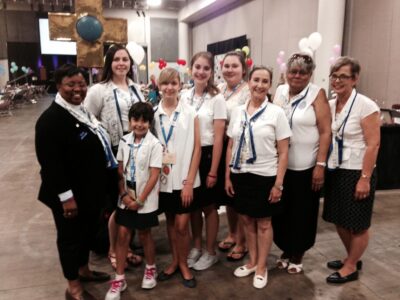
Girls Friendly Society Triennial Delegation 2015

Girls Friendly Society delegation Triennial 2015

This year is the first year that the Girls Friendly Society has had a presence at the Triennial. The GFS is 138 years old having had its beginnings in England. Mrs. Elizabeth Townsend created the organization to assist young women who were coming into the cities to work. Their motto “Bear ye one another’s burdens and so fulfill the law of Christ” is carried out through various service projects both locally and internationally.

We welcome the GFS USA to Triennial.

2020-05-20T14:57:44+00:00June 25th, 2015|

Fortune-Telling Slave Girl

Fortune-Telling Slave GirlI find it intriguing that the voice within the slave girl had something wonderful and profound to say: “These men are the slaves of the Most High God, who proclaim to you a way of salvation.” And yet Paul was irritated and commanded the spirit to come out of the girl. My initial thought is to see her as quite the opposite of an irritant and more as a prophet, like John the Baptist, who came before another and declared the truth. Jesus never got irritated with John’s rantings, but then no one ever expects Paul to behave like Jesus.

William Barkley writes in his commentary on The Acts of the Apostles that the slave girl was called a Pytho, a person who could give oracles to guide others about the future. A Pytho was considered mad and was respected by the people who believed that the gods had taken away the mad one’s wits and replaced them with the minds of the gods.

Of course, I write from what I read, and on the surface I see a girl who is saying good things about Paul and the others, and so must be a prophetess to be heeded. But delving deeper and learning about the original Greek, I discover that the word used to describe the girl’s voice is “false prophet”. No matter what good may be said, if it comes from Satan it may be real but it is not good. And Paul’s irritation is not just with an annoying voice that follows him around, again understanding the original Greek, but irritation of anger and sadness, anger at the slave owners and sadness of the girl’s plight.

The beauty of Bible Women: All Their Words and Why They Matter is the depth of learning that the Rev. Lindsay Hardin Freeman has provided for us. We begin with Scripture and a few words spoken by a woman or a girl. We look at the verses surrounding those words and see why the woman is important to the story. We dig deeper, into others’ commentaries to learn more from the original text and centuries of study, and we dig deeper, into our hearts and our personal experiences. We bring each of the women into the 21st Century to understand why they are all still relevant today.

I give thanks to Lindsay+ for taking me on a journey to meet new friends, 93 extraordinary women who said enough to be included in the Holy Bible. I thank her for giving my imagination the freedom to end the stories as I want to see them ended. The fortune telling slave girl? Why, she came back to hear Paul and Silas speak again and there met Lydia, the seller of purple. The girl was adopted into Lydia’s household and adopted into the Household of Christ.

I give thanks to the Episcopal Church Women for coming along on the journey and for sharing their insights with me and with others, either through this blog or in book study groups. I know the studies will continue, long into the future.

++++ Coming June 26th, 2015 ++++

Breakfast with Lindsay Hardin Freeman

48th Triennial Meeting – Salt Lake City

Content provided by Author Lindsay Hardin Freeman

Illustration: Claire Elam
2020-05-22T18:42:26+00:00May 15th, 2015|

Sapphira and Lydia

Sapphira and LydiaHave you ever served on a stewardship or pledge campaign committee? I have. Not only does the committee work to encourage members of the congregation to give and hopefully tithe in support of the church’s programs and operating expenses, the committee works to educate people on the reason to pledge and how to pledge reasonably. Emphasis on the love of God, the love of God’s creation, and the love of God’s people are all elements of good stewardship education. And it doesn’t matter if the church is large or small, with a healthy endowment fund or none at all; there is always a need for everyone to participate and share in the financial wellbeing of the church. As the campaign goes along, the committee is able to gauge its success, and there may be a call for more giving with a supplemental pledge. The needs of the church are emphasized and the campaign pulls not only on the purse strings, but also on the heart strings. However, never is there a call for anyone to put their personal financial situation in jeopardy in order to meet the church’s goals.

Sapphira and her husband, Ananais, remind me of church members who get too caught up in the joy of giving. The stewardship sermon stirs the heart and there is a desire to solve all the problems and meet all the goals that have been brought to the people. These church members make a pledge, one they plan to fulfill, but as the year progresses the payments lag and by the end of the year the pledge is not met. And perhaps the budget income is not met, and the church scrambles to determine what program, what staff member, or what building need will have to take the hit. Ananais and Sapphira said they would sell their land and give all the proceeds to the Christian community. No one asked them to give up everything; it was their pledge to make. But when the time came to tell Peter and the others the sale price for the land, Ananais lied to Peter. When Peter confronted him, not about how much was given, but about the lie, Ananais fell dead. Wow! Peter is some pledge campaign committee chair! At my church we receive reminder letters if we still owe on our pledge; we hold a Catch-Up Sunday in February to give people one last chance to complete their previous year’s pledge. Peter’s style is quite different from the low-key Episcopal way.

And then Peter asked Sapphira about the pledge and the price for the land. Sapphira answered “Yes, that was the price.” Sapphira was caught up, too, in the excitement of supporting the fledgling community. She made the pledge, too, and she lied about the land’s proceeds. It is best to make an honest and reasonable pledge that can be met, than to raise expectations for those planning for the new year’s ministry.

Now Lydia is an ideal pledger. She was a businesswoman who also was stirred by the “stewardship” sermon. But she responded by pledging not only a portion of her wealth, but more importantly her heart and soul. She and her household were baptized, making a more important commitment to God than any money can buy. I can almost hear Jesus’ words being said about Lydia that Jesus spoke to Martha about her sister, Mary: “She has chosen the better part.” Lydia stayed committed to the new community by opening her home to those who were spreading the Good News to the people of Philippi. “If you have judged me to be faithful to the Lord, come and stay at my home.” Sapphira was judged to be a liar and died for her lies; Lydia was judged to be faithful in her pledge of time, talent, and treasure.

It is for each of us to look at our own commitments to God. What have you pledged from your stores of time, talent, and treasure? Have you set realistic goals? Is the Holy Spirit your partner in meeting those goals? Is there more that you can do to help spread the Good News of Jesus Christ?

++++ Coming May 15th ++++

 Chapter 28

The Fortune-Telling Slave Girl

Content provided by Author Lindsay Hardin Freeman

Illustration: Claire Elam

2020-05-22T18:40:43+00:00May 1st, 2015|

National Board Scholarship for Graduate Study

ECW National Board Scholarship for Graduate Study for Ordained Ministry and the Helping Professions Application Deadline March 31, 2015

The Episcopal Church Women National Board Memorial Scholarship Fund was recently established with a gift of $50,000.00 from the Board.    Those who wish to engage in graduate study in areas related to church work, special ministries, and helping professions are eligible to apply for scholarship grant awards.

Scholarship applicants may apply for a $3,000 maximum annual award for a period of up to 3 years.  Applicants must complete an application form and submit a recommendation from a clergy member of The Episcopal Church. Completed applications are due March 31, 2015.  Awards will be announced at the 2015 Triennial Meeting in late June.

Contributions made to the Memorial Scholarship Fund during the 2012 – 2015 Triennium will be specially recognized at the 2015 Triennial Meeting.  Contributions should be made payable to DFMS with ECW Scholarship Fund in the Memo Line and mailed to Kathy Mank, ECW National Board Treasurer

2020-05-19T18:09:04+00:00April 15th, 2015|
Go to Top