
Columbia Food Bank at St. Paul’s Episcopal Church, Columbia, PA Province III
Over 60 years ago, in the mid-1950s to the mid-1960s, St. Paul’s Episcopal Church Women served free, hot lunches to the community six days a week. It quickly became evident that many of the people who came in for lunch did not have food to start or end the day. Community members were living in hunger. The ECW started sending groceries home with them after each lunch. And the food bank was started.
The food bank was partially supported by state and federal programs, which provided free food and equipment. Additionally, food and monetary donations, and volunteers from the local area, helped the food bank meet the community’s people in need. In order to receive free food, people could sign up for a voucher at the local Community Action Program (CAP) office, present it to the food bank, and take their groceries home.
In 2006, St. Paul’s discovered that the voucher system was no longer including a screening process. After a number of meetings, the church elected to forego all government support and become self-sufficient even though it meant losing free food and government-provided refrigeration equipment. The food bank instituted a screening and qualification system that was still in force prior to the pandemic.
In 2013, St. Paul’s Episcopal Church decided it was in the best interest of the church, the food bank, and the community to have the food bank become a separate corporation with its own 501 (c) (3) designation. On September 18, 2014, The Columbia Food Bank received its nonprofit status as a charitable organization.
In 2020, the food bank served 1,043 households, or 2,053 individuals, which equates to 41,657 meals. From 2019 to 2020 there was not a dramatic change in the number of people they served but more the demographics. There was a shift of the 61 and older population that stayed home, and therefore those numbers dropped while the working force numbers rose.
Community giving of both money and food has skyrocketed. Financial organizations outside their normal territory are giving. A Chicago-based company sent them a donation because an owner who was originally from the Columbia area had decided that the Columbia Food Bank would be their charity of choice. In 2019 their food distributions were 66,000 pounds, and in 2020 distributions rose to 69,000 pounds.
The food bank staff feel fortunate as even in the midst of COVID, they continue to receive donations. At times they needed to go on scouting missions, like all of us, for certain items like jelly and hot dogs. The day we spoke they received 35 $25 gift cards to a local grocery store for perishables. They have never had to turn anyone away. “We adapt and persevere.”
Information provided by Danielle Peters and Sue Ollar and the Columbia Food Bank columbiafoodbank.org
 Acerca del autor
 About the Author
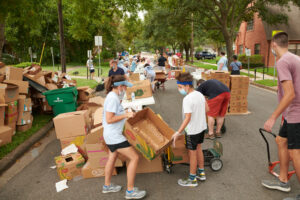 It started with a little blessing box beside the church and has become a major ministry to the community, and it couldn’t have come at a better time. The blessing box evolved into a weekly Houston Food Bank distribution site. Then, in the middle of the third month of operations, the pandemic hit. At this time, the organizers pivoted to a drive-through distribution, which at its peak has been visited by over 400 families a week. The parish hall, previously used for Christian formation and fellowship, became a food storage warehouse for pallets upon pallets of non-perishable food items.
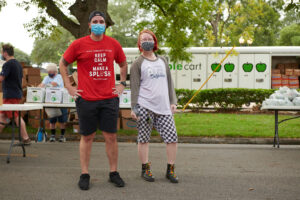 The drive-thru option allowed food to be given out in a safe way by the volunteers boxing up the food and then guests driving through the parking lot and the food delivered to their trunks. Some of these folks waited in the car line for up to two hours to get their food. It was calm and ordered, and all who received food were profoundly grateful.
 My name is Monica Elias-Orellana. I was born in California and moved to Chelsea, Massachusetts, when I was 11 years old. It was then that I was introduced to the Episcopal Church, where I found myself embraced by God’s call to “serve thy neighbor.” I was taught early in life that I must help others even if I possess little.
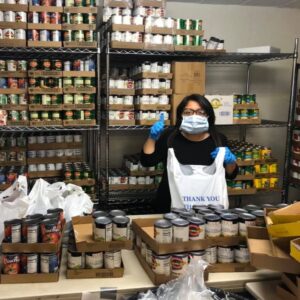 For me it is an honor to work with community members who, with love and dedication, serve families in need. My heart is full of joy and my eyes rejoice at seeing the beauty of local community members coming together to help one another. I have met incredible people who have worked many hours unloading boxes of food into the church, unpacking them, and distributing the food and other necessities given to the community. I admire that labor of love despite fears of exposure to the deadly virus. I am moved as I watch families come to the pantry for food and sometimes see tears and expressions of gratitude as they receive what they need to survive these difficult times.
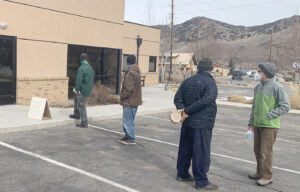 by Samar Fay