

Conversation with Ms. Helen Patmon
 by The Reverend Ema Rosero-Nordalm
Social Justice Chairperson, NECW
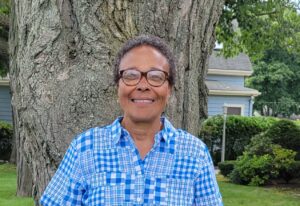
It was an honor and a joyful occasion to hear Helen Patmon share what she considers a sacred calling. Helen is a lay leader in a parish on the North Shore of Massachusetts who has worked with issues of race, racism, and racial justice with Episcopal congregations for many years.
Helen has invited individuals and communities to journey together as beloved communities transformed by God’s love, and with a deep desire to serve those who are different than themselves. This is a dream come true for Helen. She says with a smile, “It is all I love to do, I cannot remember not doing this work, and I am sure that it is what God wants me to do”. While I listened, I felt that I was in the presence of a strong, blessed and wise woman. Our time together was a loving embrace by God’s spirit.
Helen grew up in segregated Oklahoma in what she identified as a “Black-centric” family. She remembers skirting around the places she was not allowed to be as a Black person. When Helen shared her fear with her mother, she would be told, “that’s life, and we have to cope.” Even before she was five years old, she grew up “dealing” with white people; she attended a white school, so she learned how to navigate an interracial environment from an early age.
Throughout her school years Helen also found that God’s love supported her as did the relationships she developed with white peers and teachers. With a passionate voice she said that this approach to God, peers, and allies is why she has worked with communities “and why I continue doing so”.
Helen was raised in a Black Baptist church, and she recalls feeling God’s presence in worship but especially when she sang in the choir; she understood God through song. Since then, she says, “God is all one thing to me…a saving grace to me.”
Helen believes that work with racially different Episcopal congregations must include music to allow the group to connect their emotions and their physical bodies. She has come to realize that the process is slow because the tendency of many from white cultures is to intellectualize their emotions.
“Doing the work of body, mind and spirit opens the possibility to healing.” For Helen, singing is a way to go from the intellectual to the emotional and to touch the spiritual; she also believes that music changes one’s physical condition. “We can access God’s Spirit through the music. And dance will also radiate inside of you and around you.”
In her work, she brings participants from the white congregation, and they are immersed in a world that is not white, into a group that is from a mostly Black and diverse congregation willing to share their stories and experiences so their voices can be heard with the dignity that is deserved.
Books are read and discussed at the gatherings. The group is invited to respond to questions such as, “Did anything you read change how you live your life every day or with your family?” Answers to such questions can be challenging when white participants come to realize that white privilege, a sense of supremacy and historical oppression is a reality in their family and history.
The presence of tension restricts the spirit of healing. She shares with the group that what is most important is to give voice to what they are learning and feeling, to know that they are in a safe space where mutual respect among the group members has been agreed upon. This is especially important for Black women. Helen finds that white allies in the group can be helpful when tensions arise in conversation.
The group has learned a lot about each other in the work they have done so far. Strong relationships have been forged. They talk about who they are in the world, and how they can rely on transformative love when the going gets tough. “It is love that is spiritual, it comes from the whole self and that love develops by working together.”
The participants have worked in affinity groups but for the most part, the group prefers to work together and work as one interracial group. Helen says that being in a large group helps prevent some of the white participants from saying ‘crazy stuff’, not realizing that it is offensive. The Black participants have learned how to hold people accountable with compassion. Helen says, “we have come together in tough times. Honesty is transformative. Safety is also important because feeling unsafe in not conducive to transformation.”
As a leader, Helen shepherds participants through a process that reveals difficult and painful experiences. This is accomplished with allies, and it takes time. “Rushing through this does harm to the process.”
When the white congregation engaged in this process, their goal was to learn and grow in such a way that would allow them to serve their neighboring communities of color and approach them with dignity and respect. Helen walked with them and, along with members of her home congregation, has developed a community devoted to becoming a beloved community.
After four years of work, Helen can report with a full heart that “everyone has experienced change and witnessed growth, which is healing. They are now ready to get to work”. What work? To support community organizing by partnering with organizations serving those in need. For this joint work, Helen continues to serve as a guide, offering the necessary companionship and support they might need. She feels that being on the journey with the participants is crucial to maintain this community of leaders.
Besides this labor of love, Helen is a member of the Racial Justice Commission in the Diocese of Massachusetts. Her subcommittee works with the diocesan staff and Episcopal congregations to create accountable and transparent structures, in their hiring practices, search committees’ processes, and business practices.
The Racial Justice Commission has five subcommittees centered in God with constant prayer to help alleviate the pain and work together toward healing. Helen believes that the work of the Commission will advance the realization of a dream for Episcopal dioceses, congregations, and communities to truly become beloved communities.
 Escrito por el Reverendo y Diacono Twilla R. Two Bulls Provincia VI
 Escrito por Rick Stanitis
 Escrito por Janice N. Meyer, BA, MDiv
 The Diocese of Colorado is a patchwork of communities, some diverse, some homogeneous. The diocese has many efforts aimed at loving, inclusive membership among all people. Many small, rural communities are mostly white, so the majority of the ministries of inclusion are in the large metropolitan area of Denver and its suburbs.
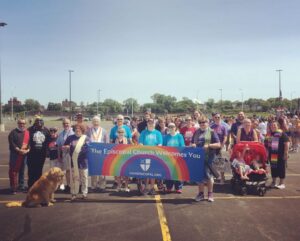 “Uno, dos, tres, cuatro, ¡todos son bienvenidos!” Cantando, yo marche por primera vez, al lado de Episcopales y luteranos, en la Marcha del orgullo Gay llevada a cabo en Syracuse, Nueva York, el 16 de junio de 2018. Marchando sobre el área renovada de la ciudad, donde rebosaban pancartas del orgullo Gay, globos hacienda alusión a lo mismo, sombreros, y paraguas que fueron abundantemente visibles, y a la vez usados por los asistentes y el clero de diversas orientaciones sexuales, de ambas denominaciones. El Reverendo Peter Williams, rector de la iglesia de la Gracia y El Espíritu Santo en Cortland, New York, una congregación episcopal y luterana, fue el gran representante de la marcha del Orgullo Gay del 20218. Una gran Multitud de personas llenaban las calles que caminamos.