Articles

National ECW Rejoices: Episcopal Church Welcomes Missionary Diocese of Navajoland

St. Christopher’s Episcopal Church in Bluff, UtahThe National Episcopal Church Women (ECW) join in joyful celebration and thanksgiving with the Episcopal Church as it welcomes its newest diocese — the Missionary Diocese of Navajoland — a historic and Spirit-filled step affirmed on June 24, 2025. After decades of faithful ministry, prayer, and perseverance, Navajoland is no longer just an area mission—it is now a fully recognized missionary diocese, embracing its sacred identity while moving boldly toward self-determination and leadership within the wider church.

For the women of the ECW, whose hearts are deeply rooted in supporting ministries that uplift communities through faith and service, this moment is cause for heartfelt rejoicing. The elevation of Navajoland is not just an institutional change; it is a powerful recognition of a people who have long lived into the Gospel with cultural integrity, resilient hope, and deep reverence for the traditions of the Diné people.

The National ECW gives glory to God for this milestone. We rejoice with our sisters and brothers in Navajoland, whose faith, perseverance, and vision now shine as a beacon to the whole church. We especially give thanks for our Province VIII ECW President, Madeline Sampson, and her family’s involvement in bringing about this historic event.

2025-07-03T16:18:21+00:00July 3rd, 2025|

Episcopal Church Women Stand in Solidarity with Missing and Murdered Indigenous Women

Missing And Murdered Indigenous WomenThe National Episcopal Church Women (ECW) is called to action in support of Missing and Murdered Indigenous Women (MMIW), a crisis affecting Indigenous communities across the United States and beyond. As faithful women of prayer, compassion, and advocacy, the ECW recognizes the urgency of raising awareness, supporting healing, and partnering with Indigenous leaders to bring justice and protection to Native sisters and their families.
According to the U.S. Department of Justice, Indigenous women face murder rates more than ten times the national average in some areas, and thousands of Native women and girls have gone missing or been murdered with little attention or resolution. The crisis is a complex and ongoing issue rooted in historical injustices, systemic violence, and jurisdictional challenges.

How ECW Can Make a Difference

  1. Amplify Indigenous Voices
    ECW groups across provinces, dioceses, and parishes are encouraged to learn from and partner with Native leaders and organizations already working tirelessly on the front lines. Listening to Native voices, inviting Indigenous speakers to ECW events, and sharing their stories can help center those most impacted.
  2. Host Awareness Events
    Local ECWs can organize prayer vigils, red dress installations, or film screenings to shed light on MMIW. The red dress has become a national symbol of remembrance and visibility. Hosting an event during Indigenous Peoples’ Month in November can bring communities together in sacred remembrance and advocacy.
  3. Support Indigenous Ministries
    Many Episcopal dioceses—including the Missionary Diocese of Navajoland and the Diocese of Alaska—have ministries deeply connected to Native communities. ECW can support these ministries with prayer, presence, financial resources, and grant applications dedicated to empowering Indigenous women and children.
  4. Pray
    The power of prayer remains at the heart of ECW’s mission. It is important that we include MMIW victims and their families in our prayers. Creating liturgies or including petitions for MMIW in Sunday services remind congregations of their shared responsibility.


The National ECW is committed to walking alongside our Indigenous sisters, holding space for grief, and lifting up the light of hope. Our baptismal covenant calls us to seek and serve Christ in all persons and strive for justice and peace among all people.

2025-07-03T16:03:48+00:00July 3rd, 2025|

Reflections from the 69th United Nations Commission on the Status of Women: Beijing +30 Meeting

By Susan Howland

It was a delight to join members of the National ECW board and others at the UNCSW: Beijing +30 meeting in March. The Commission focuses on gender equality and the rights and empowerment of women and girls and this session will review outcomes from the Beijing Declaration  and Platform for Action and make recommendations for improvement.    I have been following this meeting  and the Beijing Declaration and Platform for Action since 1995,  but this was the first time I traveled to New York City to attend in person. I attended a number of parallel events, organized by NGO Committee on the Status of Women/New York, and listened to women’s stories from all over the world. Women spoke of many joys and challenges, but the message I heard was that over the last 30 years the Beijing Platform for Action had provided a foundation for women to bring women’s voices, sometimes slowly, into cultural, social, and governmental structures. The global network has provided a place for women to gather, discuss and give voice to the varied challenges that women face in their local context.

2025-04-04T13:49:29+00:00April 4th, 2025|

National Day of Awareness for Missing and Murdered Indigenous Women and Girls

MMIW LogoWear Red on May 5 in Recognition of

National Day of Awareness for Missing and Murdered Indigenous Women and Girls


Breaking the Silence: Justice for Missing and Murdered Indigenous Women

The crisis of Missing and Murdered Indigenous Women (MMIW) is a human rights emergency that has persisted for far too long, affecting Indigenous communities across North America. Despite its devastating impact, the epidemic has been largely ignored by mainstream society. It is time to break the silence, demand justice, and take meaningful action to protect Indigenous women and girls.

How You Can Help

Addressing the MMIW crisis requires collective action. Here are ways you can make a difference:

  • Raise Awareness: Share information about MMIW on social media, attend awareness events, and support Indigenous-led organizations.
  • Hold Governments Accountable: Contact lawmakers to push for policies that prioritize justice for Indigenous women and hold law enforcement agencies accountable.
  • Support Indigenous-Led Efforts: Donate to organizations that support MMIW families, attend events and rallies that support the cause.
  • Listen to Indigenous Voices: Amplify the stories of families affected by the crisis and center Indigenous perspectives in advocacy efforts.
  • Contact your State & Congressional Lawmakers– Write letters and emails to your state legislators and congressional delegation advocating for MMIW legislation.

The time to act is now. Indigenous women deserve safety, justice, and the right to live without fear. By standing together, we can break the silence and bring an end to this crisis.

2025-04-03T15:34:01+00:00April 3rd, 2025|

Mira Washington from Church Women United

Mira Washington Church Women United with 2023 Board Mira Washington from Church Women United, CWU, spoke to the board this past Saturday while they all met in Syracuse for a board meeting. She went on to visit with the board members for the rest of the weekend and shared many delightful stories about the lives of Christian women and how their dedicated service is honored around the world.

The CWU is celebrating their 82nd year and Ms. Washington is their youngest elected president. She was raised in the organization and has been a member for nearly thirty years. “Social justice is not just my passion but Church Women United’s passions,” she said. “In fact, the CWU was one of the organizations in operation following World War Two when Elinor Roosevelt went looking for assistance in rebuilding after the war.”

“The average age of women in the organization is 78 years old. We are diversified from all ethnic cultures.” They advocate for women and the issues that impact women. Since her term started, they have developed a vision statement and focused on a true cause. Her hope is to rekindle participation in the World Day of Prayer.

She went on to explain what Justice and Righteousness means to Church Women United:

  1. Health Equity – God’s Word: On hearing this, Jesus said, “It is not the healthy who need a doctor, but the sick. But go and learn what this means: ‘I desire mercy, not sacrifice. For I have not come to call the righteous, but sinners.” Matthew 9:12-13 NIV
  2. Climate Stewardship – God’s Word: But ask the animals, and they will teach you. Or the birds in the sky, and they will tell you; or speak to the earth and it will teach you, or let the fish in the sea inform you. Which of all these does not know that the hand of the Lord has done this? In his hand is the life of every creature and the breath of all mankind. Job 12:7-10
  3. Social justice – God’s Word: “In the temple courts (Jesus) found people selling cattle, sheep, and doves and others sitting at tables exchanging money. So he made a whip out of cords, and drove all from the temple courts, both sheep and cattle; he scattered the coins of the money changers and overturned their tables. To those who sold doves he said, ‘Get these out of here! Stop turning my Father’s house into a market.” His disciples remembered that it is written, ‘Zeal for your house will consume me.’” John 2: 14-17
  4. Hunger and poverty – God’s Word: He will bring justice to the poor of the people; He will save the children of the needy and will break in pieces the oppressor. Psalm 72:4 NKJV

“We ask our regions and their member states to align themselves with the Church Women United national organization’s policies. We are sustaining ourselves on donations from state and local groups,” she said. They have also been blessed with endowments from many of their long-term members.

Their social policies have been written since 1941. “We are still facing some of the ethnic and gender national policies that are substandard for women in our culture.”

She speaks of harmony in the home and in the church. “We work to support all denominations as they come to us for assistance. I’ll be very transparent; I am very traditional, and my husband is progressive.” As churches evolve to a more progressive policy, she sees the first hurdle being harmony at home and then the congregation.

2023-08-11T15:04:53+00:00August 11th, 2023|

A Favorite Chapter Christmas Version of 1 Corinthians Chapter 13

If I design fabulous Christmas cards, with flaw-less family photos and write newsy, clever Christmas letters about my perfect life, but have not love, I’m a phony friend.

And if I have super power to remember the correct sizes and color preferences of everyone on my list; and if I have faith to find parking on Black Friday, but have not love, I am nothing.

If I give my Christmas bonus to the church, and work all day Saturday greening up the church, handing out shower towels and free soup, but have not love, I gain nothing.

If I trim the tree with Waterford angels and Pottery Barn stars, attend the Bishop’s Christmas party, and sing in the community chorus, but do not focus on Christ, I have missed the point.

Love stops to comfort a whimpering child and then wipe up the broken eggs. Love climbs down the ladder to set aside her many strings of lights, to hang a wreath for an elderly neighbor next door.

Love is kind… and tired; a lot of tired.

Love does not envy the animated Disney characters, dancing to surround-sound music on the neighbor’s light-covered rooftop.

Love does not yell at the kids to get the basket-ball off the breakfast table, but is thankful for a family breakfast together.

Love seeks to encourage, support and intentionally help.

Love rejoices in giving to those who cannot.

Love does not engage in political angst, but seeks common ground and celebrates the freedom to disagree.

Love bears all things, believes all things, hopes all things, and endures all things. Love never fails.

Love is action. Love is work; hard work.

Barbie’s shoes will be lost, remote control batteries will die, sweaters will shrink, jewelry will tarnish – Santa might even be elected; but the gift of love will last forever.

Because the greatest of these is love.

By Cindy Cutts, Talk Story Editor-in-Chief – St. Jude’s Episcopal Church on Hawaii Island

“Love is kind… and tired; a lot of tired”

2021-12-03T15:35:15+00:00December 3rd, 2021|

The Episcopal Churchwomen – The First 150 Years

To better understand how the Episcopal Church Women came into being, let’s look at a little bit of the Episcopal Church history.

In the 1830’s the General Convention of the Episcopal Church organized or reorganized the Domestic and Foreign Missionary Society to support missionary bishops sent to the western frontier to establish small dioceses. They were to be paid by the Board of Missions, but the stipends were small. At the time women in the church had no real standing, but they supported the missionaries with what was called “box” work, i.e. care packages with some of the supplies they would need- food, altar vessels, linens, etc. The missionary work expanded to overseas locations and the work continued.

In the 1850’s because of the industrial revolution, the men went to work in the factories and the women no longer had to help with the family- owned farms or other family businesses. Therefore, they had more time and were anxious to become involved in ministries of the church having to do with the social order. At that time the female diaconate was encouraged and the women began a nursing ministry, founded an orphanage and a training school for women.

The women’s auxiliary to the Board of Missions was authorized by the General Convention in 1871. Of the trust funds available to the Board of Missions at least 50% came from women.

The first Triennial meeting was held in New York in 1874 at the same time and place as the 31st General Convention.

In the early 1900’s other organizations and programs for women flowed from the auxiliary: In 1885 the Daughters of the King was established to be devoted to prayer and evangelism; In 1877 The Girls Friendly was formed to pay attention to female factory workers; in1888 the Church Periodical Club began purchasing Christian literature for parishes in the American west; and in 1889 the United Thank Offering gave funding to female missionaries.

In 1920 the national Council recognized the Executive Board of the Women’s Auxiliary.

By 1922 a national Board had been formed to oversee the direction of the work of women not only in supporting missionaries, but in social service, religious education, and prayer and worship.

The Auxiliary also advocated for growing roles for women in the church. In 1939 the first woman to receive a Bachelor of Divinity degree was from an Episcopal seminary and in 1947, 3 women completed a 2 year program in Christian education which was co-sponsored by the Women’s Auxiliary to the Board of Missions.

Prior to the 1958 Triennial Meeting, the Women’s Auxiliary became the General Division of Women’s Work.

At the 1958 The Triennial Meeting bylaws were adopted which designated diocesan groups to be known as the Episcopal Church Women. The organization supported the ordination of women to the priesthood and that women should be seated as delegates.

By 1968 the Executive Council and the General Division of Women’s Work voted to integrate planning and work of women into the total program of the church.

In 1985 the Triennial Meeting adopted bylaws forming Episcopal Church Women, Episcopal Church, USA.

Regular publication of the Communique commenced in 1988 and in 2001 the national website was launched.

Today the women continue to uphold the social justice programs of the church; feeding the hungry, supporting the immigrants, advocating for housing equity, supporting education, giving comfort to the sick, shut-ins, the marginalized, and the status of women around the world.

Barbara Taylor

St. John’s, Springfield Gdns.

Diocese of Long Island


2021-05-24T12:39:23+00:00May 24th, 2021|

Healing in Yarn with the Diocese of Chicago

Chaplain-Micheal-at-Rush-Hospital-Chicago

Chaplain Micheal at Rush Hospital Chicago

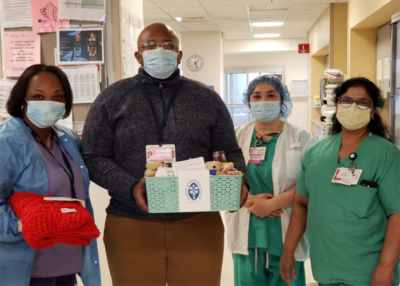
Bishop Anderson House provides spiritual care training to lay persons as well as caring for the spiritual needs of the patients, families and staff of Stroger Cook County Hospital and other Illinois Medical District hospitals. Chaplains serve people who are shaken by gun violence and severe traumatic injuries. The Teddy Bear Ministry shares cuddly bears with pediatric patients, but often adult patients or medical staff appreciate a Teddy Bear for comfort. Prayer shawls have become a welcome part of Bishop Anderson’s outreach. The following is an article that they posted honoring the creators of these special care items.

She hurried up to the chaplain, asking if there were any more prayer shawls at the office; the medical unit stash was depleted. When the chaplain returned with an especially attractive shawl, the nurse threw up her arms excitedly, grabbed the shawl and wrapped it around her own shoulders. A devoted cadre of knitters and crocheters create these beautiful symbols of caring and love for the patients, families and staff that chaplains Micheal and Rose visit at Stroger and Rush hospitals. We are especially grateful to the following Prayer Shawl and Knitting Ministries for their donations:

• Trinity Episcopal Church, Wheaton
• Church of the Holy Nativity, Clarendon Hills
• St. Augustine’s Episcopal Church, Wilmette
• St. Paul & the Redeemer, Chicago
• Emmanuel Episcopal Church, LaGrange
• Church of the Holy Spirit, Lake Forest
• St. Michael’s Episcopal Church, Barrington

The Chicago ECW has a program called “knitogether” where knitting ministries can share ideas and projects.  We have prayer cards for knitters that might be useful.  They are posted on our website: https://www.ecwchicago.org/knitogether

Submitted by: Beth Petti


Episcopal Church Women Logo

When republishing any article or poem from this website it is necessary to cite the author as well as the National Episcopal Church Women as the publisher of the content. 

2020-08-14T15:09:50+00:00August 5th, 2020|

St. Francis Episcopal Church Sews Masks for Local Hospital

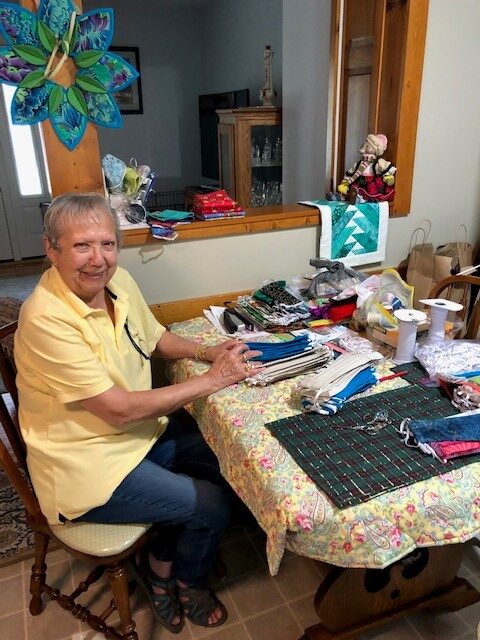
Donna BernertWhen shortages of PPE were reported throughout the nation as the pandemic took hold in mid-March, the women of St. Francis Episcopal Church in Eureka, Missouri mobilized to offer their services to St. Luke’s Hospital in Chesterfield.  The volunteer coordinator at St. Luke’s asked if they could make cloth masks for the support staff giving the quantity thought to be needed in the near future.  Overwhelmed with the number given them, Donna Bernert, a member of St. Francis contacted the Diocese of Missouri ECW Board, asking if they could mobilize volunteers across the diocese to sew cloth masks.

The ECW Board approved the appeal and Deborah Caby, current president of the ECW Board, Dio.MO, made sure all logistics and safety protocols were in place and put out an appeal to the women of the diocese asking for help in sewing masks. Within the hour of being published, the phone began to ring with dozens of women from the various parishes in the diocese offering their time and talent in sewing cloth masks. The diocesan ECW Board acted as liaison between individual volunteers and the women of St. Francis, and took over the administrative details.

Donna Bernert and Sally Hader, members of St. Francis, spearheaded this pickup ministry. They designed a system where sewing materials were prepared, assembled into kits complete with all materials needed to make 25-30 masks. Delivery of kits followed stringent safety protocols to keep everyone safe during this project.  Several men assisted with driving and member Charlie Coleman made meals for the women at St. Francis so they could utilize their time assembling kits and sewing masks. Not a detail was skipped. In a few short weeks, over 3100 masks were delivered to St. Luke’s.

This was all accomplished without members from St. Francis or members throughout the Diocese of Missouri leaving their home. Social contact was perhaps a wave from a window, but many times, no one saw each other’s face. While the work was solitary, the bonds of sisterhood and friendship grew.

Sally HaderBlessings seem to overflow when doing the work of The Lord.  St. Francis is a very small parish but met the challenges of shortages of materials as businesses shut down and lack of funding for the ministry, with the belief God would provide what was needed to do the work.  They found friends along the way who donated materials and money to make sure the support staff at St. Luke’s had cloth masks.  There were several volunteer sewers who did not attend church, but hopefully will remember the seeds of Love planted through this ministry.

With thanksgiving, the women of St. Francis acknowledge the outpouring of love from women around our diocese. The women of St. Francis have now turned their attention to sewing cloth masks for the Episcopal churches in the diocese, as they begin opening their doors for worship. Over 500 masks were delivered to various parishes with an additional 25 specially designed masks by Sally Hader were delivered to St. Thomas Deaf Episcopal Church with clear plastic inserts added, allowing worshipers the ability to read lips.

Submitted by Deborah Caby, President

ECW Board, Diocese of Missouri


Episcopal Church Women Logo

When republishing any article or poem from this website it is necessary to cite the author as well as the National Episcopal Church Women as the publisher of the content. 

2020-08-18T14:20:16+00:00July 18th, 2020|

Living with COVID-19

Being confined at home and keeping physical distance from dearly loved ones as are our families, friends and faith community, more than ever has revealed to us our vulnerabilities and how much we depend on each other and belong together in this globalized broken and hurting world.

In Spanish we say: “nuestras vidas penden de un hilo” (our lives hang from a string) which means that at any time an accident, a grave illness, or any type of violence out of our control, can cause us to lose our life. Believe or not, right now our lives and the lives of the entire five continents hang by a thread at the hands of a novel virus called the coronavirus that has practically paralyzed most of human activity. Those of us still alive, desperately cling to the hope that our last hour will not come.

In the silence of our homes that have become our refuge, we try to make sense of these unprecedented times praying for all of us. We reach out to our loved ones, writing and calling friends from the present and past. We are moved to tears when we hear any story related to this pandemic, stories of great and humble deeds for other human beings generously offered by men, women and persons of all ages. Those we will never meet but for whom we will be forever grateful.

During this time of turmoil another side of our nation has surfaced. We can no longer hide it under any pretense: this land is not the land of opportunity for all. This microscopic colorless lethal virus has brought to our astonished gaze each one of the social inequities and inequalities we knew existed, and for which many conscientious souls tried to offer solutions to end the suffering, but as this pandemic advances we see them clear as the morning light.

Desperately embracing the hope to survive this pandemic, we try to imagine what the future will be after the Covid-19 virus is under control and or after a vaccine is developed to protect us from this horrible plague. Right now, all we can do is follow guidelines we are told will keep us from exposing ourselves, and protect our neighbors, our loved ones, and everybody from the virus. We can also offer prayers and connect with one another to listen and to offer amiable advice to calm the anguish, the grief, and the uncertainty that has become the normal in our lives.

Rev. Ema Rosero-Nordalm

Social Justice Representative

2020-04-20T18:55:57+00:00April 20th, 2020|
Go to Top